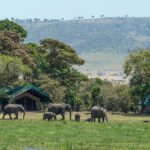


A wildebeest herd is not a still thing. It is dust, hooves, breath, calves, decisions, and movement.
From a distance, wildebeest can look almost plain beside giraffes, zebras, elephants, and big cats. Then the herd begins to move, and the animal’s importance becomes clear. Heads swing low. Tails flick. Calves press close to their mothers. Bulls grunt from temporary territories. The whole plain seems to loosen and flow.
The wildebeest is one of Africa’s great grazing animals and one of the central characters of the savanna. In East Africa, its migration is one of the most dramatic wildlife movements on Earth. In southern Africa, resident herds shape grasslands, feed predators, and anchor open-country ecosystems. To understand the wildebeest is to understand rain, grass, predators, birth, and the ancient pull of movement across wild land.
Quick Facts Table
| Quick Fact | Details |
|---|---|
| Common name | Wildebeest |
| Also known as | Gnu |
| Main safari species | Blue wildebeest |
| Scientific name | Connochaetes taurinus for blue wildebeest |
| Other living species | Black wildebeest, Connochaetes gnou |
| Animal group | Mammal, antelope |
| Family | Bovidae |
| Subfamily | Alcelaphinae |
| IUCN status | Blue wildebeest: Least Concern; black wildebeest: Least Concern |
| Population trend | Blue wildebeest generally stable overall; black wildebeest increasing in many managed areas |
| Main range | Eastern and southern Africa |
| Habitat | Savannas, open grasslands, floodplains, open woodland, and semi-arid plains |
| Diet | Herbivore, mainly grazer |
| Main food | Short grasses and fresh green growth |
| Social structure | Herds, bachelor groups, female groups, and territorial bulls |
| Famous behavior | Long-distance migration in some blue wildebeest populations |
| Gestation | About 8 to 8.5 months |
| Typical young | One calf |
| Main predators | Lions, spotted hyenas, African wild dogs, cheetahs, leopards, and Nile crocodiles |
| Responsible viewing note | Give migrating herds space, never block crossings or movement routes, and avoid separating calves from mothers |
What Is a Wildebeest?
A wildebeest is a large African antelope in the genus Connochaetes. Wildebeest belong to the family Bovidae, the same broad family as cattle, buffalo, goats, sheep, and many antelopes.
There are two living species:
| Species | Scientific Name | Main Region |
|---|---|---|
| Blue wildebeest | Connochaetes taurinus | Eastern and southern Africa |
| Black wildebeest | Connochaetes gnou | Southern Africa |
The blue wildebeest is the species most safari travelers encounter. It is also the animal at the center of the famous Serengeti-Mara migration. The black wildebeest, also called the white-tailed gnu, is smaller, darker, and more strongly associated with southern African grasslands.
Wildebeest are built for grazing and movement. Their bodies may seem front-heavy, with high shoulders, a sloping back, curved horns, a long face, and a beard-like mane. They are sometimes described as odd-looking, but every part of the animal suits its life on open plains.
Top Questions
Yes. Wildebeest are antelopes in the family Bovidae.
There is no real difference. “Gnu” is another common name for wildebeest.
No. Some blue wildebeest populations migrate seasonally, but others are resident. Black wildebeest are generally more local or nomadic rather than famous long-distance migrants.
Wildebeest mainly eat grasses, especially short, fresh, nutrient-rich growth after rain.
Migratory herds follow seasonal rainfall, water, and grazing. Movement helps them find fresh grass and avoid exhausting one area.
Blue wildebeest and black wildebeest are currently listed as Least Concern globally, but some local populations and subspecies have declined.
General Characteristics
Wildebeest have large heads, broad muzzles, curved horns, high shoulders, slim hindquarters, long tails, and shaggy manes or beards. Their appearance combines features that can remind observers of cattle, antelope, and horse-like movement, but wildebeest are true antelopes.
Blue wildebeest are usually slate-grey to dark brown, often with darker vertical striping on the shoulders and neck. Their horns curve outward and then upward. Black wildebeest are darker, with a pale or white tail and horns that curve forward before sweeping upward.
Both males and females have horns. Males are generally larger and more strongly built, especially around the neck and shoulders. Bulls use their horns in contests, territorial defense, and displays.
Wildebeest are strong runners and can move quickly when threatened. Their best defense is often group movement: many eyes watching, many bodies moving, and calves protected within the herd.
Habitat and Distribution
Wildebeest live in eastern and southern Africa, mainly in open habitats where grasses are abundant. They use savannas, grasslands, floodplains, open woodland, lightly wooded plains, and semi-arid grazing areas.
Blue wildebeest occur across parts of Tanzania, Kenya, Zambia, Zimbabwe, Botswana, Namibia, South Africa, Mozambique, Angola, and nearby regions, though distribution varies by subspecies and local conservation history.
Important safari landscapes include the Serengeti-Mara ecosystem, Ngorongoro, Tarangire, Ruaha, Kafue, Liuwa Plain, Okavango Delta, Chobe, Hwange, Etosha, Kruger, and many private and community conservation areas.
Black wildebeest are native to southern Africa. Their historical range was heavily reduced by hunting and land conversion, but they have recovered in many protected reserves, private wildlife areas, and managed landscapes in South Africa, Namibia, Eswatini, and Lesotho.
Wildebeest need grazing and water, though their dependence on water varies with season, rainfall, and habitat. Migratory populations are especially vulnerable when fences, farms, roads, or settlements block traditional routes.
Behavior and Social Life
Wildebeest social life changes with season, rainfall, food, and breeding.
In migratory systems, huge herds may form as animals move across the landscape in search of grass and water. These herds are not random. They are shaped by local decisions, memory, scent, rainfall, grazing quality, and the movement of other animals.
During the rut, male wildebeest establish temporary territories and try to attract females. Bulls grunt, paw the ground, scent-mark, chase rivals, and display with lowered heads and arched necks. In dense breeding areas, many small territories may sit close together.
Females and young often move in groups, while young males may form bachelor herds. Territorial bulls hold ground when conditions make it worthwhile, but in migratory systems the pace of the herd can force territories to be temporary.
Wildebeest communicate through grunts, snorts, bellows, body posture, scent marking, tail movements, and herd movement. Their calls are one of the background sounds of many African plains.
Diet and Grazing
Wildebeest are specialized grazers. They feed mainly on grasses, especially short green growth after rain. Their broad muzzle helps them crop grasses efficiently close to the ground.
Their feeding strategy connects them closely to rainfall. Fresh grass after rain is rich in nutrients, especially for pregnant and lactating females. In East Africa, wildebeest movements are strongly tied to the seasonal pattern of rain, water, and grass quality.
Wildebeest often graze alongside zebras. Zebras can feed on taller, coarser grasses first, making way for the shorter, fresher grasses that wildebeest prefer. This relationship helps structure mixed grazing systems.
By grazing, moving, calving, and dying across large areas, wildebeest help cycle nutrients through savanna ecosystems. Their dung fertilizes grasslands, their grazing shapes plant growth, and their bodies support predators and scavengers.
Migration
The best-known wildebeest movement is the Serengeti-Mara migration, involving blue wildebeest along with zebras and gazelles. The migration is not a neat circle on a calendar. It changes with rain, grass, fire, water, and local conditions.
Generally, herds move across the Serengeti plains during calving and wet-season grazing, then shift toward dry-season areas as water and grass change. Some animals cross into Kenya’s Maasai Mara, though timing varies from year to year.
River crossings are the most dramatic migration scenes. Wildebeest may gather at riverbanks, hesitate, surge forward, turn back, and cross in large numbers. Crocodiles, steep banks, panic, and exhaustion make crossings risky.
Not all wildebeest migrate. Many blue wildebeest populations are resident, moving locally rather than across vast distances. This matters because the species should not be reduced to one famous migration. Resident herds are also ecologically important.
Reproduction and Life Cycle
Wildebeest breeding is often seasonal. In many East African populations, mating takes place near the end of the rainy season, when animals are in good condition. Calving often happens near the start of the wet season, when grass is fresh and milk production is easier.
Gestation lasts about 250 to 260 days, or roughly 8 to 8.5 months. A female usually gives birth to a single calf.
Wildebeest calves are famously quick to stand. Within minutes, many can rise and begin moving. This is essential in open country, where lions, hyenas, cheetahs, leopards, wild dogs, and jackals may threaten young animals.
In large migratory populations, calving can be highly synchronized. Thousands of calves may be born within a short period, overwhelming predators through sheer numbers. Even so, predation can be intense.
Calves stay close to their mothers, learning movement routes, herd behavior, grazing, and predator awareness. Survival depends on nutrition, weather, herd size, predator pressure, and the ability to keep up.
Predators and Ecosystem Role
Wildebeest are one of Africa’s most important prey animals. Lions, spotted hyenas, African wild dogs, cheetahs, leopards, and Nile crocodiles all hunt them, though predator success varies by age, health, terrain, and herd behavior.
Calves, sick animals, old individuals, and animals separated from the herd are most vulnerable. Adult wildebeest are strong and can injure predators with horns and hooves.
Their ecological role is enormous in places where herds are large. Wildebeest grazing influences grass height, fire patterns, nutrient cycling, predator populations, scavenger activity, and the movement of other herbivores.
In the Serengeti, wildebeest are not just one species among many. They are a major force in how the whole ecosystem functions.
Taxonomy
Kingdom: Animalia
Phylum: Chordata
Class: Mammalia
Order: Artiodactyla
Family: Bovidae
Subfamily: Alcelaphinae
Genus: Connochaetes
| Species | Scientific Name | Common Name |
|---|---|---|
| Blue wildebeest | Connochaetes taurinus | Blue wildebeest, brindled gnu |
| Black wildebeest | Connochaetes gnou | Black wildebeest, white-tailed gnu |
Commonly discussed blue wildebeest subspecies include the common blue wildebeest, Cookson’s wildebeest, eastern white-bearded wildebeest, western white-bearded wildebeest, and Nyassaland wildebeest, though treatment can vary by source.
Conservation Status
Both blue wildebeest and black wildebeest are currently listed as Least Concern globally by the IUCN. This does not mean all wildebeest populations are secure.
Blue wildebeest remain abundant in some major ecosystems, especially where large protected landscapes still allow seasonal movement. However, some local populations and subspecies have declined because of fencing, agricultural expansion, livestock competition, hunting, settlement, disease, and blocked migration routes.
Black wildebeest were once reduced severely by hunting and habitat conversion in southern Africa. Their recovery is an important conservation success, helped by protected areas, private wildlife ranches, translocations, and active management. However, many populations remain managed or fenced, and hybridization with blue wildebeest can be a concern in some areas.
Major threats include:
- Habitat loss and fragmentation.
- Fences blocking migration routes.
- Competition with livestock.
- Reduced access to water.
- Illegal hunting and local overharvest.
- Disease transmission.
- Drought and climate pressure.
- Agricultural expansion.
- Hybridization risk between blue and black wildebeest in managed areas.
Conservation priorities include maintaining migration corridors, protecting calving grounds, managing livestock-wildlife interfaces, preventing inappropriate hybridization, supporting community conservancies, and keeping large grazing systems connected.
Human Relationship and Responsible Travel
Wildebeest are sometimes overlooked because they are common in famous safari areas, but they deserve careful viewing. Their behavior tells the story of the plains: where rain has fallen, where predators are hunting, where calves are vulnerable, and where movement is beginning.
Responsible travelers should give herds space, especially during migration, calving, river crossings, and predator encounters. Vehicles should never block a crossing point, force animals toward water, split mothers from calves, or push a herd into panic for photographs.
At river crossings, patience is essential. Wildebeest may gather for hours or days before crossing. Pressure from vehicles can change decisions and increase risk. The best guides allow natural movement and keep a respectful distance.
During calving season, avoid crowding newborn calves or hunting scenes. The goal is not to force drama, but to witness wild behavior without changing it.
A good wildebeest sighting is not just a view of an animal. It is a view of movement itself.
Final Reflection
The wildebeest is not polished in the way people often expect safari beauty to be. It is bearded, blunt-faced, restless, and noisy. But give it time, and its greatness appears.
A wildebeest is rain made visible in animal form. It follows grass, feeds predators, carries nutrients, births calves in waves, and writes migration routes across the continent. Its survival depends on something simple and difficult: enough connected land to keep moving.
To watch wildebeest well is to watch the savanna working.