
A pangolin does not announce itself.
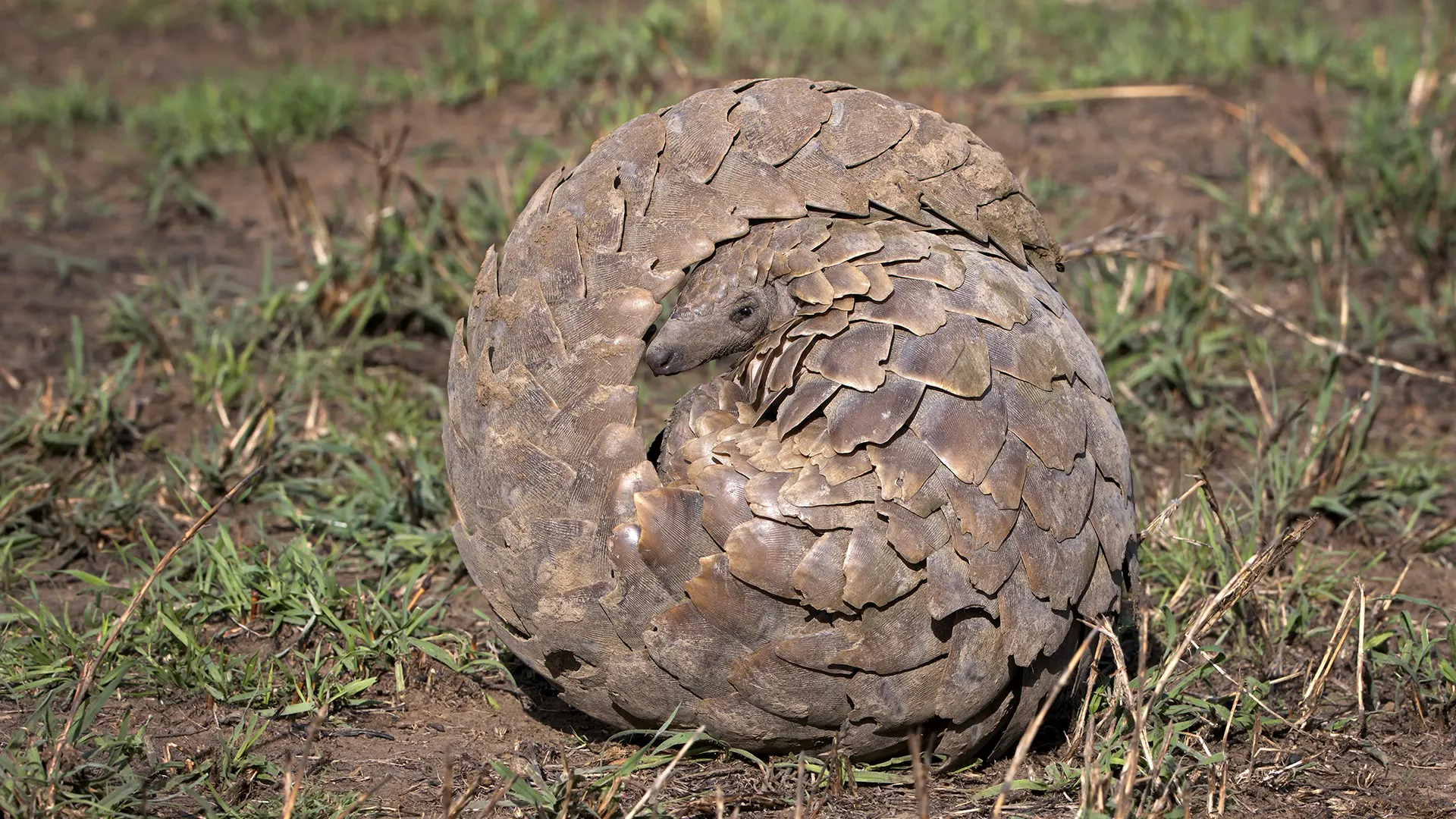
It moves quietly through the grass or forest floor, nose low, claws testing the soil, body covered in overlapping scales that look almost carved rather than grown. When danger comes, it does not run like an antelope or fight like a predator. It curls into a tight living shield, protecting its soft belly inside a coat of keratin.
This defense worked for millions of years against lions, leopards, hyenas, and other natural threats. It does not work against people.
Pangolins are among the most unusual mammals on Earth and among the most heavily trafficked. They are insect hunters, soil turners, termite specialists, and secretive night wanderers. To understand a pangolin is to understand how a quiet animal can carry one of the loudest conservation warnings in the world.
Quick Facts Table
| Quick Fact | Details |
|---|---|
| Common name | Pangolin |
| Also known as | Scaly anteater |
| Animal group | Mammal |
| Order | Pholidota |
| Family | Manidae |
| Living species | Eight species: four in Africa and four in Asia |
| African species | Temminck’s ground pangolin, giant ground pangolin, white-bellied pangolin, black-bellied pangolin |
| Asian species | Indian, Chinese, Sunda, and Philippine pangolins |
| IUCN status | All eight species are threatened with extinction |
| African conservation status | Temminck’s ground pangolin: Vulnerable; black-bellied pangolin: Vulnerable; white-bellied pangolin: Endangered; giant ground pangolin: Endangered |
| Diet | Insectivore |
| Main food | Ants, termites, larvae, and other social insects |
| Distinctive features | Keratin scales, long sticky tongue, powerful claws, small head, no teeth |
| Activity pattern | Mostly nocturnal, though some activity varies by species and region |
| Social structure | Mostly solitary |
| Defense | Curls into a tight ball when threatened |
| Typical young | One pup |
| Gestation | Varies by species; often several months |
| Main threats | Illegal wildlife trade, poaching, habitat loss, electric fences, roads, mining, and local hunting |
| Responsible viewing note | Never touch, handle, follow, spotlight harshly, or reveal the location of a wild pangolin |
What Is a Pangolin?
A pangolin is a scale-covered mammal in the order Pholidota. Pangolins are not reptiles, armadillos, or anteaters, even though they may remind people of all three. They are mammals with warm blood, live young, and milk-producing mothers.
Their scales are made of keratin, the same basic protein found in human fingernails, hair, and rhino horn. These scales cover much of the body, leaving the belly, face, and inner limbs softer and more vulnerable.
Pangolins have no teeth. Instead, they use a long sticky tongue to collect ants and termites. Their tongues are extraordinary: in some species, the tongue is longer than the head and body combined and is anchored deep inside the chest region.
There are eight living pangolin species: four in Africa and four in Asia. All are threatened, and all are affected by illegal trade, habitat loss, and human pressure.
Top Questions
Yes. Pangolins are mammals, even though their scales make them look reptile-like.
Pangolin scales are made of keratin, the same basic material as human fingernails and hair.
Pangolins eat mainly ants and termites. They use strong claws to open nests and a long sticky tongue to collect insects.
Pangolins are trafficked for their scales, meat, and other body parts. Demand is linked to illegal wildlife trade, traditional medicine markets, luxury meat consumption, and local use.
Against natural predators, yes. They curl into a tight ball protected by scales. Against human poachers, this defense makes them easier to pick up.
Yes. All eight pangolin species are threatened with extinction. Some are listed as Vulnerable, others as Endangered or Critically Endangered.
General Characteristics
Pangolins are immediately recognizable because they are the only mammals covered in large overlapping scales. These scales grow from the skin and form a protective armor across the head, back, sides, tail, and limbs.
Their bodies are low, elongated, and muscular. The head is small and tapered, the eyes are small, and the ears are reduced or simple depending on species. Their sense of smell is especially important for finding food.
Pangolins have powerful curved claws used for tearing into termite mounds, ant nests, rotting logs, and soil. Because the front claws can be long and awkward for walking, some ground pangolins move with the forefeet curled under or may even walk partly on the hind legs with the tail used for balance.
The tail varies by species. Arboreal pangolins, such as the black-bellied and white-bellied pangolins, have long prehensile tails that help them climb. Ground pangolins have heavier bodies and strong tails used for balance and defense.
When threatened, a pangolin curls into a tight ball. The head tucks inward, the soft belly is hidden, and the scales face outward. Some species may also release a strong-smelling secretion from anal glands.
The Eight Pangolin Species
African Pangolins
| Species | Scientific Name | General Range | Conservation Status |
|---|---|---|---|
| Temminck’s ground pangolin | Smutsia temminckii | Eastern and southern Africa, extending into parts of Central Africa | Vulnerable |
| Giant ground pangolin | Smutsia gigantea | Central and West Africa, with some East African records | Endangered |
| White-bellied pangolin | Phataginus tricuspis | West and Central African forests | Endangered |
| Black-bellied pangolin | Phataginus tetradactyla | West and Central African forests | Vulnerable |
Temminck’s ground pangolin is the African pangolin most likely to be discussed in safari contexts, especially in southern and eastern Africa. It lives in savannas, semi-arid areas, grasslands, and woodlands.
The giant ground pangolin is larger and more forest-associated. It is secretive and rarely seen.
White-bellied and black-bellied pangolins are arboreal forest species. They are lighter, more tree-adapted, and use their tails for climbing.
Asian Pangolins
| Species | Scientific Name | General Range | Conservation Status |
|---|---|---|---|
| Indian pangolin | Manis crassicaudata | South Asia | Endangered |
| Chinese pangolin | Manis pentadactyla | China and parts of South and Southeast Asia | Critically Endangered |
| Sunda pangolin | Manis javanica | Southeast Asia | Critically Endangered |
| Philippine pangolin | Manis culionensis | Palawan and nearby Philippine islands | Critically Endangered |
Asian pangolins have been heavily depleted by trafficking and habitat loss. As Asian populations declined, illegal trade pressure increasingly shifted toward African pangolins.
Habitat and Distribution
Pangolins live across parts of Africa and Asia, with habitat depending strongly on species.
African ground pangolins use savannas, grasslands, woodlands, semi-desert, bushveld, and open country with termite and ant availability. Temminck’s ground pangolin is especially associated with savanna and woodland habitats in eastern and southern Africa.
Giant ground pangolins live in forests and forest-savanna mosaics. White-bellied and black-bellied pangolins are mainly forest species, using trees, vines, hollows, and dense vegetation.
Asian pangolins occupy forests, grasslands, agricultural edges, scrublands, and mixed habitats, though many populations are now fragmented and heavily reduced.
A pangolin’s habitat must provide enough ants and termites, shelter, and safe movement routes. Burrows, hollow logs, tree cavities, termite mounds, and dense cover are all important depending on species.
Behavior and Social Life
Pangolins are mostly solitary. Adults generally come together only to mate, and the strongest social bond is between a mother and her young.
Most species are mainly nocturnal, though activity can vary with temperature, season, age, disturbance, and region. In some areas, Temminck’s ground pangolins may show daytime activity during certain seasons.
They are quiet animals. Much of their behavior involves slow searching, scenting, digging, feeding, resting, and moving between foraging areas. Ground pangolins may use burrows or shelter sites, while tree pangolins rest in hollows, dense vegetation, or tree cavities.
Pangolins communicate through scent marking, urine, feces, body contact, and probably subtle vocal or movement cues. Because they are so secretive, much remains unknown about their wild behavior.
Diet and Feeding
Pangolins are specialized insectivores. Their main foods are ants and termites, though the exact species eaten varies by region and pangolin species.
They use their strong claws to break into insect nests, termite mounds, rotting wood, or soil. Then they extend a long sticky tongue to collect insects. Small stones or grit may be swallowed to help grind food in the stomach, since pangolins have no teeth.
A pangolin may feed from many insect colonies rather than destroying one completely. This can allow colonies to recover and provide food again later.
Their feeding has ecological value. By opening termite mounds and ant nests, pangolins influence insect populations, turn soil, aerate ground, and create small feeding opportunities for other animals.
Reproduction and Life Cycle
Pangolin reproduction is slow, which makes population recovery difficult after poaching.
Females usually give birth to a single young, often called a pup. Twins are rare in some species but are not typical. Gestation varies by species, with many accounts placing it at several months.
The pup is born with soft scales that harden after birth. It stays close to the mother and may ride on her back or tail, depending on species. If threatened, the mother may curl around the young to protect it.
Young pangolins nurse for a period before gradually beginning to feed on insects. They learn shelter use, movement routes, and feeding behavior from the mother.
Because pangolins usually produce only one young at a time and may not breed rapidly, adult survival is extremely important. Heavy poaching can remove animals faster than populations can replace them.
Taxonomy
Kingdom: Animalia
Phylum: Chordata
Class: Mammalia
Order: Pholidota
Family: Manidae
| Genus | Species | Common Name |
|---|---|---|
| Smutsia | Smutsia temminckii | Temminck’s ground pangolin |
| Smutsia | Smutsia gigantea | Giant ground pangolin |
| Phataginus | Phataginus tricuspis | White-bellied pangolin |
| Phataginus | Phataginus tetradactyla | Black-bellied pangolin |
| Manis | Manis crassicaudata | Indian pangolin |
| Manis | Manis pentadactyla | Chinese pangolin |
| Manis | Manis javanica | Sunda pangolin |
| Manis | Manis culionensis | Philippine pangolin |
Pangolin taxonomy has changed over time, especially as genetic research has clarified relationships between African and Asian species.
Conservation Status
Pangolins are among the most threatened mammal groups in the world. The IUCN SSC Pangolin Specialist Group and other conservation organizations note that all eight species are threatened with extinction.
The major driver is illegal wildlife trade. Pangolin scales are trafficked for use in traditional medicine markets, while pangolin meat is consumed as a luxury or local food in some areas. There is no scientific evidence that pangolin scales have medicinal value beyond being keratin.
As Asian pangolin populations declined, trafficking pressure increasingly shifted toward African species. This has placed African pangolins under growing pressure, even in areas where they were once rarely targeted for international trade.
Major threats include:
- Illegal trade in scales, meat, and body parts.
- Local hunting and bushmeat use.
- Habitat loss and agricultural expansion.
- Deforestation and wetland or woodland degradation.
- Electric fences, especially for ground pangolins.
- Road deaths.
- Mining and infrastructure expansion.
- Low reproductive rate.
- Poorly known population sizes.
- Weak enforcement in some range areas.
Conservation work includes anti-trafficking enforcement, rescue and rehabilitation, trained wildlife crime units, community education, demand reduction, protected habitat, road and fence mitigation, research tracking, and better population monitoring.
Pangolins are difficult to count because they are secretive, often nocturnal, solitary, and naturally occur at low densities. This means many population estimates are uncertain, and declines may be hard to detect until they are severe.
Human Relationship and Responsible Travel
A wild pangolin sighting is rare and should be treated with exceptional care. These animals are sensitive, slow-moving, and highly vulnerable to disturbance and trafficking.
Responsible viewing means keeping distance, staying quiet, and never touching or handling the animal. Do not pick up a pangolin, reposition it for a photograph, shine harsh light on it, follow it closely, or reveal its exact location publicly.
If a pangolin is seen near a road, lodge, farm, or settlement, the safest response is to alert a qualified guide, ranger, or local wildlife authority rather than trying to intervene personally. Well-meant handling can cause stress, injury, or legal complications.
Travelers should never buy pangolin products, scales, curios, meat, leather, or medicine. Any pangolin product supports illegal or harmful wildlife trade.
A good pangolin encounter is quiet and protective. The best outcome is not a close photograph. It is the animal disappearing safely into the night.
Final Reflection
The pangolin is not a dramatic animal in the usual safari sense. It does not roar, charge, tower, or race. Its life is smaller and quieter: ants under bark, termites in soil, claws in earth, a pup riding its mother’s back, a curled body waiting for danger to pass.
That quietness is exactly why it matters. Pangolins remind us that conservation is not only about the animals that command attention. It is also about the hidden lives that keep ecosystems working.
To watch a pangolin well is to feel the privilege of seeing something that should remain rare, wild, and undisturbed. Its scales may look like armor, but its future depends on people choosing restraint.