
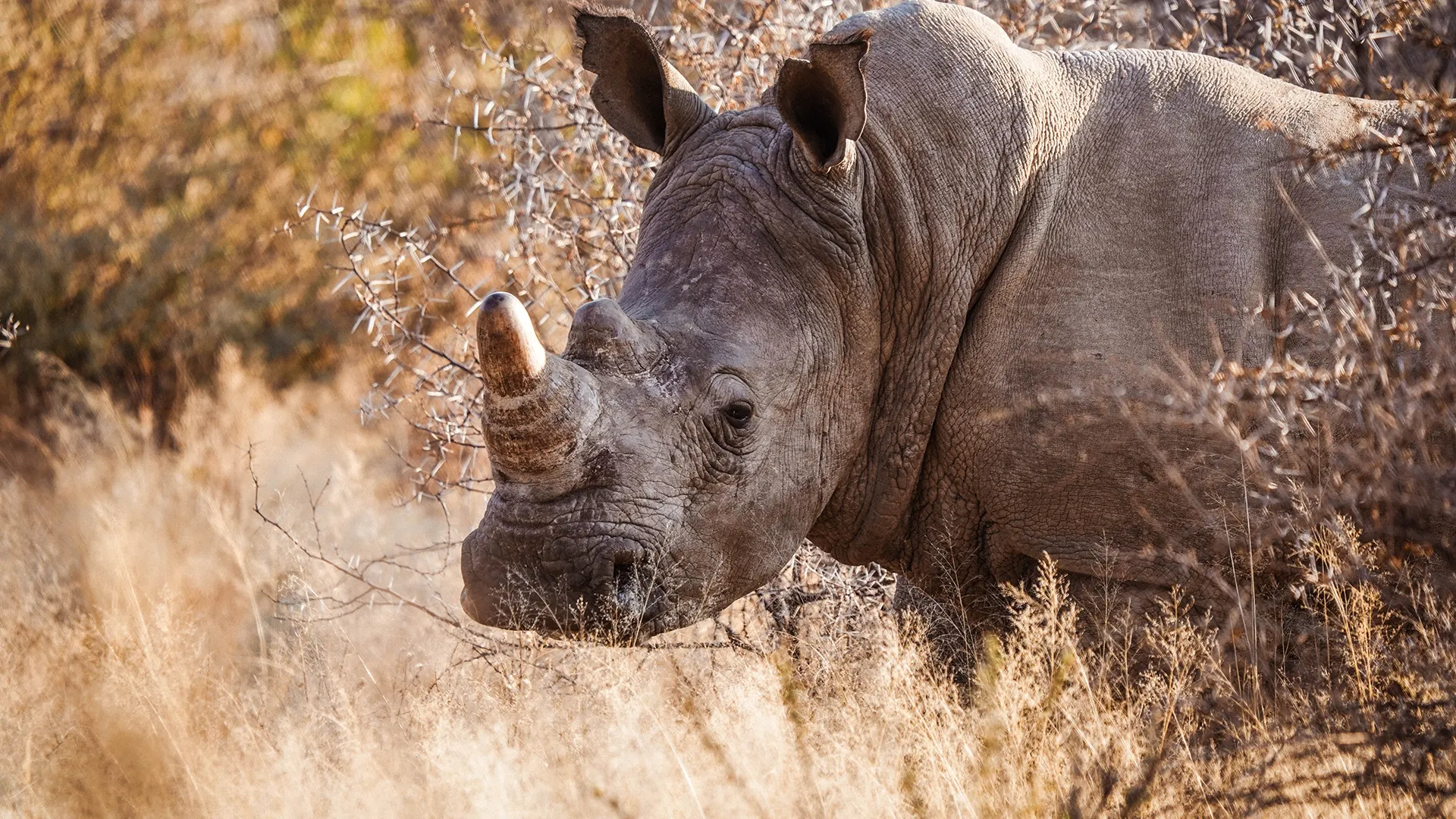
At first, a rhinoceros can look like a relic from another age: heavy-shouldered, thick-skinned, horned, and quiet under the heat of the day. Then it moves, and the impression changes. A rhino is not clumsy. It is deliberate. Every step carries weight. Every pause feels like a decision.
In African bushveld, a white rhino may graze with its head low, lips sweeping the grass like a slow mower. A black rhino may stand half-hidden in thorn scrub, alert and sharp-tempered, shaped by a life of browsing and avoiding danger. Across Asia, the greater one-horned rhino moves through tall grass and wetlands, while the Javan and Sumatran rhinos survive in such small numbers that every individual matters.
The rhinoceros is not one animal but a family of five living species, each with its own landscape, behavior, and conservation story. Together, they represent both the ancient strength of wild mammals and the modern urgency of protecting what remains.
Quick Facts
| Quick Fact | Details |
|---|---|
| Common name | Rhinoceros or rhino |
| Meaning of name | From Greek roots meaning “nose horn” |
| Animal group | Mammal |
| Order | Perissodactyla, the odd-toed ungulates |
| Family | Rhinocerotidae |
| Living species | White rhino, black rhino, greater one-horned rhino, Javan rhino, Sumatran rhino |
| Continents | Africa and Asia |
| Diet | Herbivore |
| Feeding style | Grazing, browsing, or mixed feeding depending on species |
| Horn material | Keratin, the same basic protein found in hair and fingernails |
| Typical young | One calf |
| Gestation | About 15 to 16 months, depending on species |
| Lifespan | Often 35 to 50 years in the wild, with variation by species |
| Largest species | White rhinoceros |
| Smallest living species | Sumatran rhinoceros |
| Most threatened species | Javan and Sumatran rhinos are among the rarest large mammals on Earth |
| Main threats | Poaching, illegal horn trade, habitat loss, small isolated populations, conflict, and weak protection |
| Global population | Around 26,700 wild rhinos, based on recent conservation reporting |
| Safari relevance | Rhinos are iconic, vulnerable, powerful animals that require calm, ethical viewing |
What Is a Rhinoceros?
A rhinoceros is a large herbivorous mammal in the family Rhinocerotidae. Rhinos are part of the order Perissodactyla, which also includes horses and tapirs. This group is known as the odd-toed ungulates.
There are five living rhino species:
| Species | Scientific Name | Main Range | Conservation Status |
|---|---|---|---|
| White rhinoceros | Ceratotherium simum | Southern Africa, with reintroduced and managed populations elsewhere | Near Threatened |
| Black rhinoceros | Diceros bicornis | Eastern and southern Africa, with smaller reintroduced populations | Critically Endangered |
| Greater one-horned rhinoceros | Rhinoceros unicornis | India and Nepal | Vulnerable |
| Javan rhinoceros | Rhinoceros sondaicus | Ujung Kulon National Park, Indonesia | Critically Endangered |
| Sumatran rhinoceros | Dicerorhinus sumatrensis | Indonesia | Critically Endangered |
Rhinos are famous for their horns, but their importance goes far beyond appearance. They are major grazers, browsers, seed dispersers, trail makers, and landscape-shaping animals. In some places, their survival also supports tourism, ranger jobs, conservation funding, and local economies.
Top Questions
No. Rhinos are mammals, not dinosaurs. They are modern animals with ancient evolutionary roots.
There are five living rhino species: white, black, greater one-horned, Javan, and Sumatran.
Rhino horn is made of keratin, the same basic protein found in human hair and fingernails.
Rhinos are not “aggressive” without reason, but they can be dangerous. They may charge if surprised, threatened, wounded, crowded, or protecting a calf.
White, black, and Sumatran rhinos usually have two horns. Greater one-horned and Javan rhinos usually have one horn.
The main threats are poaching for illegal horn trade, habitat loss, small isolated populations, slow breeding, and pressure from expanding human land use.
General Characteristics
Rhinos are large-bodied animals with thick skin, short legs, powerful shoulders, broad heads, and one or two horns on the nose. Despite their heavy appearance, rhinos can move quickly over short distances and are surprisingly agile in the habitats they know.
Their eyesight is relatively poor, but their hearing and sense of smell are strong. A rhino may lift its head, rotate its ears, or scent the air long before it decides whether to move away, stand its ground, or investigate.
Rhino skin is thick but sensitive. Many rhinos wallow in mud or rest in water to cool down, protect the skin from sun, and reduce irritation from biting insects. Oxpeckers and other birds may feed on ticks and parasites on African rhinos, though the relationship can be complex.
The horn is not bone. It grows from the skin and is made of tightly packed keratin fibers. Horn size varies by species, age, sex, genetics, and history. Because horn is the reason rhinos are targeted by poachers, it has become one of the most tragic features in modern wildlife conservation.
The Five Rhino Species
White Rhinoceros
The white rhino is the largest living rhino species and one of the largest land mammals. Despite the name, it is not truly white. The name is often linked to a misunderstanding of the Afrikaans word “wyd,” meaning wide, referring to the animal’s broad square mouth.
White rhinos are mainly grazers. Their wide lips are adapted for cropping grass, and they are often seen with heads low, feeding steadily across open grassland and savanna. Compared with black rhinos, white rhinos are usually more social. Females and calves may form small groups, and adult males hold territories.
There are two subspecies: the southern white rhino and the northern white rhino. Southern white rhinos are the conservation recovery story most people know. Northern white rhinos, however, are functionally extinct in the wild, with only two known females remaining under human care.
Black Rhinoceros
The black rhino is smaller than the white rhino and has a hooked upper lip adapted for browsing leaves, shoots, shrubs, and thorny vegetation. It is often more solitary and can be more reactive than the white rhino, especially in dense bush where surprise encounters happen quickly.
Black rhinos once declined catastrophically because of hunting and poaching. Their numbers have improved in some areas through intense protection, translocation, monitoring, and community-linked conservation, but they remain Critically Endangered.
In safari landscapes, black rhinos are often harder to see than white rhinos. They use thicker cover, browse more selectively, and may move in broken terrain where visibility is limited.
Greater One-Horned Rhinoceros
The greater one-horned rhino, also called the Indian rhino, is a large Asian species recognized by its single horn and folded skin that looks like natural body armor. It lives mainly in India and Nepal, especially in floodplain grasslands, wetlands, and riverine habitats.
This species was once reduced to very low numbers, but focused protection has helped it recover to more than 4,000 individuals. It remains Vulnerable because its range is limited and many animals are concentrated in a small number of protected areas.
Greater one-horned rhinos are strong swimmers and are closely associated with tall grass, marshes, and water.
Javan Rhinoceros
The Javan rhino is one of the rarest large mammals on Earth. It survives only in Ujung Kulon National Park in Indonesia. Recent conservation reporting places the population at around 50 individuals.
Javan rhinos are secretive forest animals. They are smaller than greater one-horned rhinos and usually have a single horn, though females may have very small horns or none visible. Because the entire species is concentrated in one area, it is vulnerable to poaching, disease, natural disasters, genetic problems, and habitat limits.
Every Javan rhino matters. There is no backup population elsewhere.
Sumatran Rhinoceros
The Sumatran rhino is the smallest living rhino and the only Asian rhino with two horns. It is also the hairiest rhino, with reddish-brown hair especially visible on the ears and body.
This species is closely tied to dense tropical forest. It is now reduced to very small, fragmented populations in Indonesia. Recent estimates place the population at around 34 to 47 individuals.
The Sumatran rhino’s crisis is not only about numbers. When animals are too scattered, they may fail to find mates. This makes intensive conservation, habitat protection, and carefully managed breeding efforts especially important.
Habitat and Distribution
Rhinos live in a wide range of habitats, depending on species.
African white and black rhinos use savannas, grasslands, open woodland, scrub, thornveld, semi-arid areas, and protected reserves. White rhinos are more tied to grazing lawns and open grassland, while black rhinos often prefer thicker bush and browse-rich habitats.
Greater one-horned rhinos live in floodplain grasslands, wetlands, river systems, and alluvial plains in India and Nepal. They depend on productive habitats shaped by seasonal water, tall grass, and protected corridors.
Javan rhinos live in lowland tropical forest and dense vegetation in Indonesia. Sumatran rhinos use tropical forest, hilly terrain, and remote forested landscapes.
Historically, rhinos occupied far larger ranges. Today, their distribution is fragmented by farms, roads, settlements, fences, poaching pressure, and habitat conversion.
Behavior and Social Life
Rhino behavior varies strongly by species.
White rhinos are the most social of the living rhinos. Females and calves may form groups, and young animals may associate with others. Adult males defend territories using dung middens, urine spraying, scraping, and patrol routes.
Black rhinos are usually more solitary. They communicate through scent marking, dung piles, urine spraying, body posture, snorts, squeals, and other sounds. They can be shy, curious, defensive, or unpredictable depending on the situation.
Greater one-horned rhinos are often solitary but may tolerate others in rich feeding areas, wallows, or water bodies. Javan and Sumatran rhinos are generally elusive and solitary, with much of their behavior recorded through camera traps, tracks, dung, and field monitoring.
All rhinos rely heavily on scent. Dung middens are important communication points, carrying information about identity, sex, reproductive status, and territory.
Diet and Feeding
Rhinos are herbivores, but they do not all feed the same way.
White rhinos are grazers. Their square lips are adapted for cropping grass close to the ground.
Black rhinos are browsers. Their hooked lips help them pull leaves, twigs, and shoots from shrubs and trees.
Greater one-horned rhinos feed on grasses, aquatic plants, leaves, branches, and crops when they move near farmland.
Javan rhinos browse on shoots, leaves, young foliage, and forest plants.
Sumatran rhinos browse leaves, twigs, fruit, bark, and forest vegetation.
Because of their size and feeding habits, rhinos influence vegetation structure. Grazing rhinos help maintain open grassland, while browsing rhinos shape shrubs and young trees. Forest rhinos may also disperse seeds through their movement and dung.
Reproduction and Life Cycle
Rhinos reproduce slowly, which makes population recovery difficult after heavy poaching.
Females usually give birth to a single calf after a long gestation of about 15 to 16 months, depending on species. Twins are extremely rare. A calf stays close to its mother for several years, learning feeding routes, water sources, resting areas, and danger signals.
The interval between births can be long. A female may only produce a calf every few years. This means even a small increase in adult deaths can affect the long-term future of a population.
Calves are vulnerable to predators in some areas, especially lions, hyenas, and crocodiles, but the greatest threats to rhino populations are human-driven: poaching, habitat loss, and fragmentation.
Taxonomy
Kingdom: Animalia
Phylum: Chordata
Class: Mammalia
Order: Perissodactyla
Family: Rhinocerotidae
Living genera and species:
| Genus | Species | Common Name |
|---|---|---|
| Ceratotherium | Ceratotherium simum | White rhinoceros |
| Diceros | Diceros bicornis | Black rhinoceros |
| Rhinoceros | Rhinoceros unicornis | Greater one-horned rhinoceros |
| Rhinoceros | Rhinoceros sondaicus | Javan rhinoceros |
| Dicerorhinus | Dicerorhinus sumatrensis | Sumatran rhinoceros |
Conservation Status
Rhino conservation is a mixture of progress and deep concern.
Some populations have grown because of strong protection, translocation, ranger work, veterinary care, community conservation, and habitat management. The greater one-horned rhino is one of the best-known success stories, rising from around 200 animals in the early 20th century to more than 4,000 today.
Black rhinos have also increased from their lowest point, though they remain Critically Endangered. White rhinos remain the most numerous rhino species, but recent reports show declines in some areas, especially where poaching pressure and drought have been severe.
The Javan and Sumatran rhinos are in the most urgent position. Both survive in extremely small numbers. For these species, the loss of even a few animals can have serious consequences.
Major threats include:
- Poaching for illegal horn trade.
- Habitat loss and fragmentation.
- Small isolated populations.
- Weak genetic diversity in tiny populations.
- Human-wildlife conflict.
- Political instability or weak enforcement in some areas.
- Drought and climate pressure.
- Disease risk in small concentrated populations.
- Slow reproduction.
Effective conservation often requires armed ranger patrols, intelligence-led anti-poaching work, protected-area management, community benefits, demand reduction for illegal horn, habitat corridors, veterinary support, and careful monitoring of individual animals.
Responsible Travel Relevance
Seeing a rhino in the wild is a privilege. It should be quiet, patient, and respectful.
On safari, travelers should keep a safe distance, stay seated in vehicles, avoid sudden movements, and follow the guide’s instructions. Rhinos may have poor eyesight, but they are powerful and can react quickly if they feel threatened.
Extra care is needed around mothers with calves, animals near roads, and rhinos in thick bush where they may feel surprised or boxed in. On walking safaris, rhino encounters should only happen with properly qualified guides who understand wind direction, cover, escape routes, and animal behavior.
Ethical rhino tourism supports conservation when it funds protection, local jobs, habitat management, and community benefits. It becomes harmful when animals are crowded, baited, harassed, or treated as trophies for close photographs.
A responsible rhino sighting gives the animal room to remain wild.
Final Reflection
The rhinoceros carries a rare kind of presence. It is ancient in outline, practical in behavior, and deeply vulnerable in the modern world. Its horn, once simply a tool for survival and display, has become the reason many rhinos are killed. Yet the story is not only loss. Where people protect habitat, reduce poaching, and give communities a stake in conservation, rhinos can recover.
To understand the rhinoceros is to see both strength and fragility in the same animal: a massive body, a quiet calf beside its mother, a trail through grass, a horn that should never be worth more than a life.