
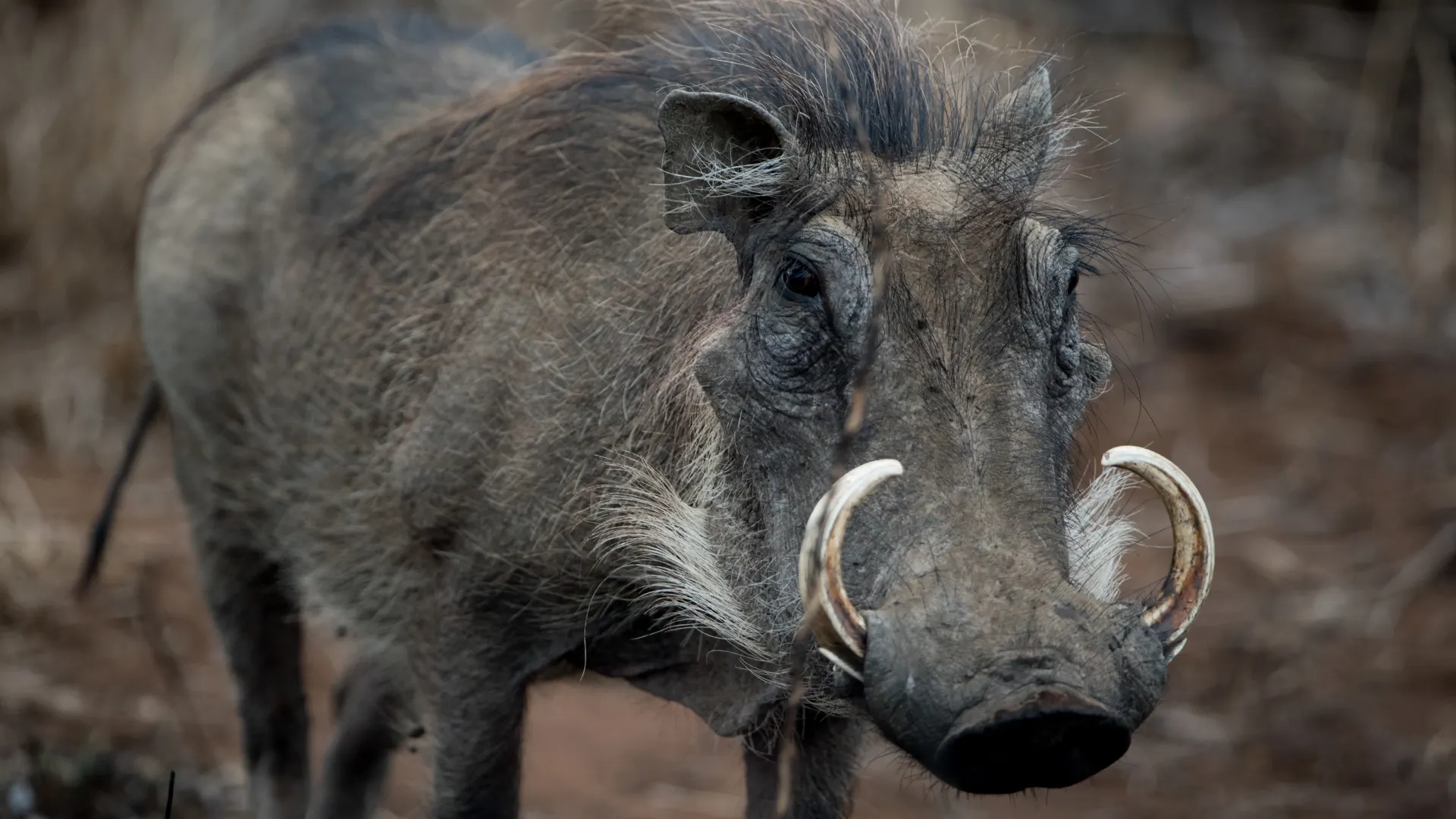
A warthog rarely arrives with elegance, and that is part of its charm.
It may appear beside a dusty track with its tail raised like a small flag, trotting through the grass with surprising confidence. Its head is large, its legs are thin, its mane stands rough along the back, and its face carries the fleshy pads that give the animal its name. Then it drops to its knees to feed, practical and unbothered, using padded forelegs to reach short grass close to the ground.
The warthog is often treated as comic relief on safari, but it is tougher and more interesting than first impressions suggest. It survives by grazing, digging, listening, running, using old burrows, and raising piglets in landscapes full of lions, leopards, hyenas, wild dogs, and eagles. To understand the warthog is to appreciate a small savanna survivor with a large personality and a deeply practical design.
Quick Facts Table
| Quick Fact | Details |
|---|---|
| Common name | Common warthog |
| Also known as | Warthog |
| Scientific name | Phacochoerus africanus |
| Animal group | Mammal, wild pig |
| Family | Suidae |
| IUCN status | Least Concern |
| Population trend | Decreasing overall in some conservation summaries, though still widespread and often locally common |
| Main range | Sub-Saharan Africa |
| Habitat | Savannas, open woodlands, grasslands, bushlands, semi-deserts, and lightly wooded areas |
| Diet | Omnivore, mostly herbivorous |
| Main food | Grasses, roots, bulbs, tubers, fruits, bark, insects, and occasional carrion |
| Distinctive features | Facial pads, tusks, upright mane, large head, kneeling feeding posture |
| Social structure | Female groups called sounders; adult males often solitary outside breeding |
| Burrow use | Often uses abandoned aardvark burrows or natural holes |
| Gestation | About 5 to 6 months, often around 170 days |
| Typical litter | Usually 2 to 4 piglets, though litter size varies |
| Lifespan | Often around 10 to 15 years in the wild; longer in managed care |
| Main predators | Lions, leopards, hyenas, African wild dogs, cheetahs, crocodiles, and large eagles for young piglets |
| Responsible viewing note | Give warthogs space near burrows, never block escape routes, and avoid separating piglets from their mother |
What Is a Warthog?
The common warthog is a wild pig native to sub-Saharan Africa. It belongs to the family Suidae, the same family as pigs, hogs, and boars. Its scientific name is Phacochoerus africanus.
Warthogs are among the most recognizable animals in African savannas. Their long faces, curved tusks, sparse hair, raised tails, and kneeling feeding posture make them easy to identify. Despite their unusual appearance, they are well adapted to open country.
They are not large compared with buffalo, rhinos, or elephants, but they are strong, alert, and fast enough to survive in predator-rich landscapes. A warthog’s first defense is usually flight. Its second defense is a burrow. Its last defense is a pair of sharp tusks used with real force.
Top Questions
They are named for the fleshy pads or bumps on the face. These are not true warts but protective facial growths, especially noticeable in males.
Yes. Warthogs often feed while resting on their padded front knees. This helps them crop short grass close to the ground.
Warthogs usually run from danger, but they can defend themselves with sharp tusks if cornered, injured, trapped, or protecting young.
They may dig or modify holes, but they often use abandoned aardvark burrows or natural holes for sleeping, raising young, and escaping predators.
They eat grasses, roots, bulbs, tubers, fruits, bark, insects, and occasional carrion. They are omnivores but feed mostly on plant material.
The raised tail may help group members follow each other through grass, especially when fleeing.
General Characteristics
Warthogs have large heads, long snouts, strong necks, short bodies, thin legs, and sparse bristly hair. A mane of longer hair runs from the head down the back and may stand up when the animal is excited or alarmed.
Their most obvious features are their tusks and facial pads. The upper tusks curve upward and outward from the mouth. The lower tusks are shorter but sharper, rubbing against the upper tusks and forming dangerous cutting edges. Males use tusks during fights and defense, while females also use them when threatened.
The facial pads are thick skin cushions, not disease growths. In males, they help absorb blows during fights. Adult males usually have larger facial pads and tusks than females.
Warthogs are built for short bursts of speed and quick escapes. When alarmed, they often run with tails raised. This raised tail is one of the classic sights of African bushveld.
Adult warthogs vary in size, but many weigh roughly 50 to 150 kg, with males generally larger than females. They are smaller than they may appear from a distance, but their head, tusks, and posture make them look bold and sturdy.
Habitat and Distribution
Common warthogs are widespread across much of sub-Saharan Africa. They occur from parts of West and East Africa through southern Africa, though their distribution is shaped by habitat, water, hunting pressure, and land use.
They prefer open and semi-open habitats, including savannas, grasslands, open woodlands, bushlands, grass-steppes, semi-desert edges, and lightly wooded areas. They generally avoid dense rainforest, true desert, and very high mountain environments.
Warthogs are often associated with areas where short grass is available. They may also use previously disturbed or grazed areas, including old livestock areas, roadsides, lawns near lodges, and burned grassland where new growth appears.
They are common in many safari regions, including the Okavango Delta, Chobe, Hwange, Kruger, South Luangwa, Kafue, Serengeti, Maasai Mara, Tarangire, Etosha, Queen Elizabeth National Park, and many private and community reserves.
Burrows are important habitat features. A landscape with good feeding but no shelter may be less useful than one with aardvark holes, termite mounds, eroded banks, or natural cavities.
Behavior and Social Life
Warthogs are mostly active during the day, though activity can shift with heat, hunting pressure, predators, and disturbance. They often feed in the cooler parts of the day and rest during extreme heat.
Females live in groups called sounders, usually made up of related females and their young. Adult males are often more solitary outside the breeding season, though they may associate loosely with others.
Warthogs rely heavily on alertness. They often pause while feeding, raise their heads, listen, and scan. Their eyesight is not their strongest sense, but their hearing and smell help them detect danger.
When threatened, warthogs usually run to cover or a burrow. They often back into burrows, leaving the tusks facing outward toward the entrance. This is a clever defense against predators trying to pull them out.
Their communication includes grunts, snorts, squeals, body posture, scent, tail position, and direct physical contact between mothers and young. Piglets learn quickly to follow their mother and disappear into shelter when alarmed.
Diet and Feeding
Warthogs are omnivores, but much of their diet is plant-based. They graze on short grasses and often kneel on their padded front knees while feeding. This posture lets them reach low grass efficiently and is one of their most recognizable behaviors.
During dry seasons, warthogs dig for bulbs, tubers, roots, and rhizomes using the snout and tusks. They may also eat fruits, bark, seeds, fungi, insects, larvae, earthworms, eggs, and occasional carrion.
Their feeding helps disturb soil, spread seeds, and influence short-grass patches. By digging and rooting, warthogs create small openings in the ground that can affect plant growth and provide foraging opportunities for birds and other animals.
Water use varies by region. Warthogs often drink where water is available, but they can survive in relatively dry environments by using moisture from food and adjusting activity.
Reproduction and Life Cycle
Warthog breeding often follows seasonal rainfall patterns, though timing varies by region. In many areas, births are timed so piglets arrive when food is improving and cover is available.
Gestation lasts about 5 to 6 months, often around 170 days. A female usually gives birth to 2 to 4 piglets, though larger litters can occur.
Before giving birth, the female may use a burrow as a protected den. Piglets remain hidden early in life and later begin following their mother outside. The burrow is essential because young warthogs are vulnerable to predators.
Piglets are small, quick, and highly dependent on their mother. They nurse for several months and gradually begin grazing. Young warthogs face danger from lions, leopards, hyenas, African wild dogs, cheetahs, crocodiles, jackals, large eagles, snakes, and disease.
If threatened, a mother may lead piglets toward a burrow, distract danger, or defend with tusks when escape is impossible. Survival improves when shelter, food, and cover are available.
Predators and Ecosystem Role
Warthogs are important prey for many African predators. Lions, leopards, spotted hyenas, African wild dogs, cheetahs, crocodiles, and large eagles may all take warthogs or piglets depending on size and opportunity.
Leopards are especially known for hunting warthogs where cover allows ambush, while lions and hyenas may target adults in open or mixed habitats. Young piglets are much more vulnerable than adults.
Warthogs also play a useful ecological role as grazers, diggers, and burrow users. Their feeding helps maintain short-grass patches, and their digging can turn soil and expose food for other species.
Their reliance on abandoned aardvark burrows also links them indirectly to other ecosystem engineers. Aardvarks create shelter used by warthogs, porcupines, mongooses, hyenas, jackals, reptiles, and many smaller animals.
Taxonomy
Kingdom: Animalia
Phylum: Chordata
Class: Mammalia
Order: Artiodactyla
Family: Suidae
Genus: Phacochoerus
Species: Phacochoerus africanus
The genus Phacochoerus includes two living warthog species:
| Species | Scientific Name | Main Region |
|---|---|---|
| Common warthog | Phacochoerus africanus | Widespread in sub-Saharan Africa |
| Desert warthog | Phacochoerus aethiopicus | Horn of Africa region, especially Kenya, Somalia, and Ethiopia |
The common warthog is the species most safari travelers encounter across eastern, central, western, and southern Africa.
Conservation Status
The common warthog is listed as Least Concern by the IUCN. It remains widespread and is often locally common in suitable habitats, including many protected areas.
However, Least Concern does not mean free from pressure. Some local populations decline where hunting is heavy, habitat is converted, disease spreads, or conflict with agriculture increases. San Diego Zoo Wildlife Alliance’s fact sheet notes a decreasing population trend, while the species remains secure compared with many larger African mammals.
Major threats include:
- Local hunting for meat.
- Habitat loss and agricultural expansion.
- Disease transmission with domestic pigs or livestock.
- Drought and reduced grazing.
- Persecution where warthogs damage crops.
- Snaring and accidental trapping.
- Fragmentation outside protected areas.
Warthogs reproduce faster than many large mammals, which helps them recover where habitat remains suitable and hunting pressure is not excessive. Their future depends on healthy savanna systems, sustainable hunting controls, disease management, and continued protection of open habitats.
Human Relationship and Responsible Travel
Warthogs are often relaxed around safari vehicles, especially in protected areas, but they should still be given space. A warthog with piglets may be nervous, and any animal near a burrow needs a clear escape route.
Travelers should avoid blocking burrow entrances, cutting between a mother and young, or forcing warthogs to run for photographs. If a warthog raises its tail and bolts, the sight may be amusing, but the animal is responding to stress or danger.
On walking safaris, guides treat warthogs with respect. A cornered warthog can slash with its tusks and cause serious injury. Burrows should never be approached casually, because they may hold warthogs or other animals.
A good warthog sighting rewards attention to ordinary details: kneeling to graze, piglets following in a line, oxpeckers feeding on backs, mud on the snout after digging, or a family disappearing backward into a burrow at dusk.
Final Reflection
The warthog is one of the great practical animals of the African savanna. It does not need elegance to be fascinating. Its strength is in usefulness: kneeling to feed, digging when grass is gone, using another animal’s burrow, raising young under pressure, and running with enough urgency to survive another day.
To watch a warthog well is to see how survival often looks ordinary before it looks impressive. A raised tail, a dusty snout, a quick glance toward a burrow, a mother with piglets in tow: these are the small signs of a life built for alertness and adaptation.