
Buffalo are famous for their strength, heavy horns, herd defense, and close relationship with water and grazing landscapes. They are part of the traditional “Big Five,” but for travelers, they are more than a checklist animal: they are ecosystem shapers, lion prey, grassland grazers, and a reminder that safari animals should always be respected on their own terms.
The African buffalo is currently listed as Near Threatened by the IUCN, with an overall decreasing population trend.
Top Questions
The African buffalo is a large wild bovine in the family Bovidae. It is related to cattle and Asian buffalo, but it has never been domesticated.
The Cape buffalo is the best-known and largest form of African buffalo, common in eastern and southern Africa. It is usually treated as a subspecies of African buffalo: Syncerus caffer caffer.
They live across parts of sub-Saharan Africa, from West and Central Africa to eastern and southern Africa. They need access to water, grass, and cover.
Yes. Buffalo are powerful, alert, and capable of defending themselves aggressively, especially old bulls, wounded animals, and cows with calves. Travelers should view them only with trained guides and from a safe distance.
African buffalo are herbivores and mainly graze grasses. They also use wetlands, floodplains, woodlands, and forest edges depending on the region.
Lions are their main natural predators. Calves may also be taken by hyenas, leopards, African wild dogs, and crocodiles.
The African buffalo is a large wild bovine in the family Bovidae. It is related to cattle and Asian buffalo, but it has never been domesticated.
General Characteristics
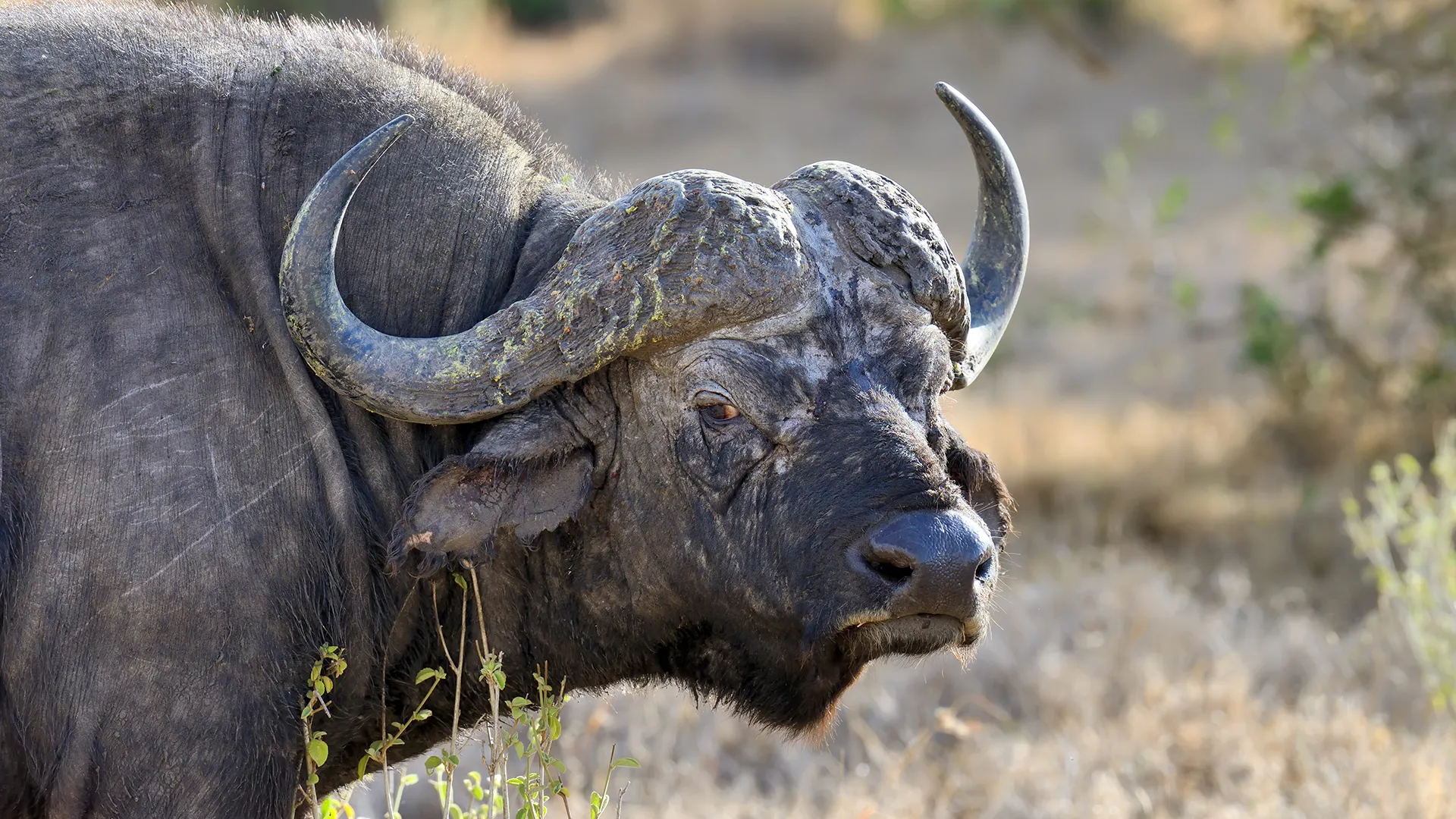
African buffalo are heavy, muscular animals with broad bodies, strong necks, sturdy legs, and large heads. Their most distinctive feature is their horns. In adult savanna buffalo, the horn bases can thicken and fuse across the forehead into a hard shield known as a boss. This is especially developed in mature bulls.
Adults vary widely in size. African Wildlife Foundation gives a broad weight range of about 300 to 835 kg, with shoulder height around 1 to 2 meters. Forest buffalo are much smaller than Cape buffalo and often have a reddish coat rather than the dark gray or black appearance typical of many savanna buffalo.
Both males and females have horns, though bulls tend to be larger and more heavily built. Older bulls may lose hair and develop a rough, scarred appearance from years of fighting, wallowing, grazing, and living in predator country.
Buffalo calves are usually reddish-brown, which can make them stand out against dark adult herds. As they mature, many darken, especially in savanna populations.
Habitat and Distribution
African buffalo live in a wide range of habitats, including savannas, floodplains, open woodlands, swamp edges, riverine areas, montane grasslands, and forests. They are flexible, but they are not desert animals. They usually need reliable water and good grazing within daily reach.
Their distribution is fragmented across sub-Saharan Africa. Strong populations remain in many protected areas and wildlife landscapes, especially in eastern and southern Africa. Important safari regions include Botswana’s Okavango Delta and Chobe, South Africa’s Kruger region, Zimbabwe’s Hwange, Zambia’s South Luangwa and Kafue, Tanzania’s Serengeti and Ruaha, Kenya’s Maasai Mara and Amboseli, Uganda’s Queen Elizabeth and Murchison Falls, and parts of Namibia, Mozambique, and Rwanda.
In Central and West Africa, forest buffalo and smaller regional forms occupy forest and forest-savanna mosaics, but many populations are under heavier pressure from hunting, habitat fragmentation, and human expansion.
Behavior and Social Life
African buffalo are highly social. Herd size can range from small groups to several hundred animals, and in exceptional seasonal conditions, much larger gatherings may form. Herds are usually built around females and their young, with adult males moving in and out depending on age, season, dominance, and condition.
Older bulls may spend time alone or in small bachelor groups. Safari guides sometimes call solitary old males “dagga boys,” a southern African term linked to their habit of wallowing in mud. These bulls can be unpredictable because they often rely on thick cover and close-range defense.
Buffalo herds are alert and coordinated. When threatened by lions, they may bunch together, place calves toward the center, face danger with horns outward, or even mob predators. A large herd can be difficult for lions to break, but isolated calves, sick animals, and old bulls are more vulnerable.
Buffalo communicate through body posture, horn displays, scent, grunts, bellows, and low contact calls. Their social life is practical and defensive: staying together improves access to information, protection, movement decisions, and calf survival.
Diet and Grazing
African buffalo are primarily grazers. They feed on grasses and are especially important in savanna and floodplain ecosystems because they can process coarse grasses that many more selective herbivores avoid.
By grazing heavily and moving through an area, buffalo can open up vegetation and create feeding opportunities for other animals. In some landscapes, zebras, wildebeest, cattle egrets, and other species may be seen near buffalo herds.
Buffalo need regular access to water and often drink daily. Their movements are shaped by rainfall, grass quality, fire, drought, predator pressure, and the availability of wetlands or permanent water sources.
Reproduction and Life Cycle
African buffalo breeding often follows seasonal rainfall patterns, though timing varies by region. In many savanna areas, calving is linked to the rainy season, when grass is more nutritious and mothers have better access to food.
Gestation lasts around 11 to 12 months. A female usually gives birth to a single calf. The calf may be hidden for a short period before joining the herd, where group protection becomes important.
Calves nurse from their mothers and remain close for safety. The bond between cow and calf is strong, and the herd’s defensive behavior can help protect young animals from predators. Lions are the main threat to adults, while calves face danger from lions, hyenas, leopards, wild dogs, crocodiles, disease, drought, and separation from the herd.
Females usually become mature after several years, while males often need more time to grow large enough to compete successfully with other bulls.
Taxonomy
Kingdom: Animalia
Phylum: Chordata
Class: Mammalia
Order: Artiodactyla
Family: Bovidae
Genus: Syncerus
Species: Syncerus caffer
Commonly discussed forms or subspecies include:
- Syncerus caffer caffer – Cape buffalo or southern savanna buffalo.
- Syncerus caffer nanus – forest buffalo.
- Syncerus caffer brachyceros – West African or Sudan buffalo.
- Syncerus caffer aequinoctialis – Nile buffalo.
- Syncerus caffer mathewsi – sometimes listed as mountain buffalo, though its status is debated.
Buffalo taxonomy is complex, and genetic research continues to refine how scientists understand regional lineages.
Conservation Status
The African buffalo is listed as Near Threatened on the IUCN Red List, with a decreasing overall population trend. Conservation status varies strongly by region. Some populations in southern and eastern Africa remain strong, especially in protected areas, while others are fragmented or declining.
Major threats include:
- Habitat loss and fragmentation.
- Illegal hunting and bushmeat pressure.
- Conflict with agriculture.
- Disease transmission between wildlife and livestock.
- Drought and climate stress.
- Fences and land-use change that disrupt movement.
- Localized overhunting where management is weak.
Population estimates vary between sources because some counts include managed or private populations while others focus more narrowly on wild or free-ranging buffalo. The clearest message is that African buffalo remain numerous in some protected landscapes, but their long-term future depends on habitat, connectivity, anti-poaching work, and coexistence with communities and livestock systems.
Human Relationship and Responsible Travel
African buffalo deserve respectful viewing. They may appear calm while grazing, but they are strong, fast over short distances, and capable of sudden defensive reactions. Travelers should never approach buffalo on foot unless they are with a properly qualified walking guide, and even then, distance and wind direction matter.
On game drives, stay seated, keep quiet, and avoid pressuring the guide to move too close. Extra care is needed around large herds, old bulls in thick cover, cows with calves, and animals near water or narrow tracks where they may feel boxed in.
Responsible photography means allowing buffalo to move naturally. Do not block their route to water, split a herd, force a resting animal to stand, or crowd animals on a road. A good buffalo sighting often comes from watching herd behavior patiently: calves tucked between adults, oxpeckers working along backs, bulls testing each other, or the entire herd lifting its heads when lions are nearby.
The African buffalo is a reminder that safari is not only about rare or beautiful animals. It is about understanding power, patience, herd life, and the practical realities of wild landscapes.