
There is a moment on safari when everything else seems to stop.
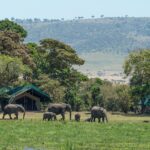
The birds go quiet. The engine is switched off. Ahead, a family of elephants crosses the road at its own pace, the matriarch leading with calm confidence while calves weave between the legs of mothers, aunts, and older sisters. The youngest explores every scent with an oversized trunk, occasionally stumbling before being gently guided back into the herd.
Nothing about the scene feels hurried.
The African elephant moves with a quiet certainty that comes from shaping landscapes for millions of years. Trees bend where it feeds, paths appear where it walks, and dry riverbeds become places of life when it uncovers hidden water. Watching elephants is less about witnessing power and more about witnessing family, memory, patience, and the remarkable intelligence of Earth’s largest land animal. It is a reminder that the greatest presence in the African wilderness is often the gentlest one.
Quick Summary
The African elephant is the largest land animal on Earth and one of the defining species of African wilderness. Today, scientists recognize two African elephant species: the African savanna elephant (Loxodonta africana) and the African forest elephant (Loxodonta cyclotis).
Savanna elephants are the giants most safari travelers see in open grasslands, floodplains, woodlands, and semi-arid landscapes. Forest elephants are smaller, darker, more secretive animals of Central and West African rainforests. Both are deeply important to the places they inhabit: savanna elephants shape grasslands and woodlands, while forest elephants disperse seeds and help maintain forest structure.
Their conservation status is serious. The African savanna elephant is listed as Endangered, and the African forest elephant is listed as Critically Endangered by the IUCN Red List.
Top Questions
There are two recognized African elephant species: the African savanna elephant, Loxodonta africana, and the African forest elephant, Loxodonta cyclotis.
Savanna elephants are generally larger, with broader ears and more outward-curving tusks. Forest elephants are smaller, darker, and have straighter, downward-pointing tusks that help them move through dense rainforest.
African elephants occur across sub-Saharan Africa. Savanna elephants are found mainly in eastern and southern Africa, with some populations elsewhere. Forest elephants live mainly in the rainforests of Central and West Africa.
They are herbivores. Their diet includes grasses, leaves, bark, roots, fruit, shrubs, branches, and aquatic plants, depending on habitat and season.
African elephant gestation lasts about 22 months, the longest pregnancy of any land mammal.
They can be. Elephants are intelligent, emotional, powerful animals. Most safari encounters are peaceful when handled well, but elephants can charge if they feel threatened, crowded, surprised, or protective of calves.
General Characteristics
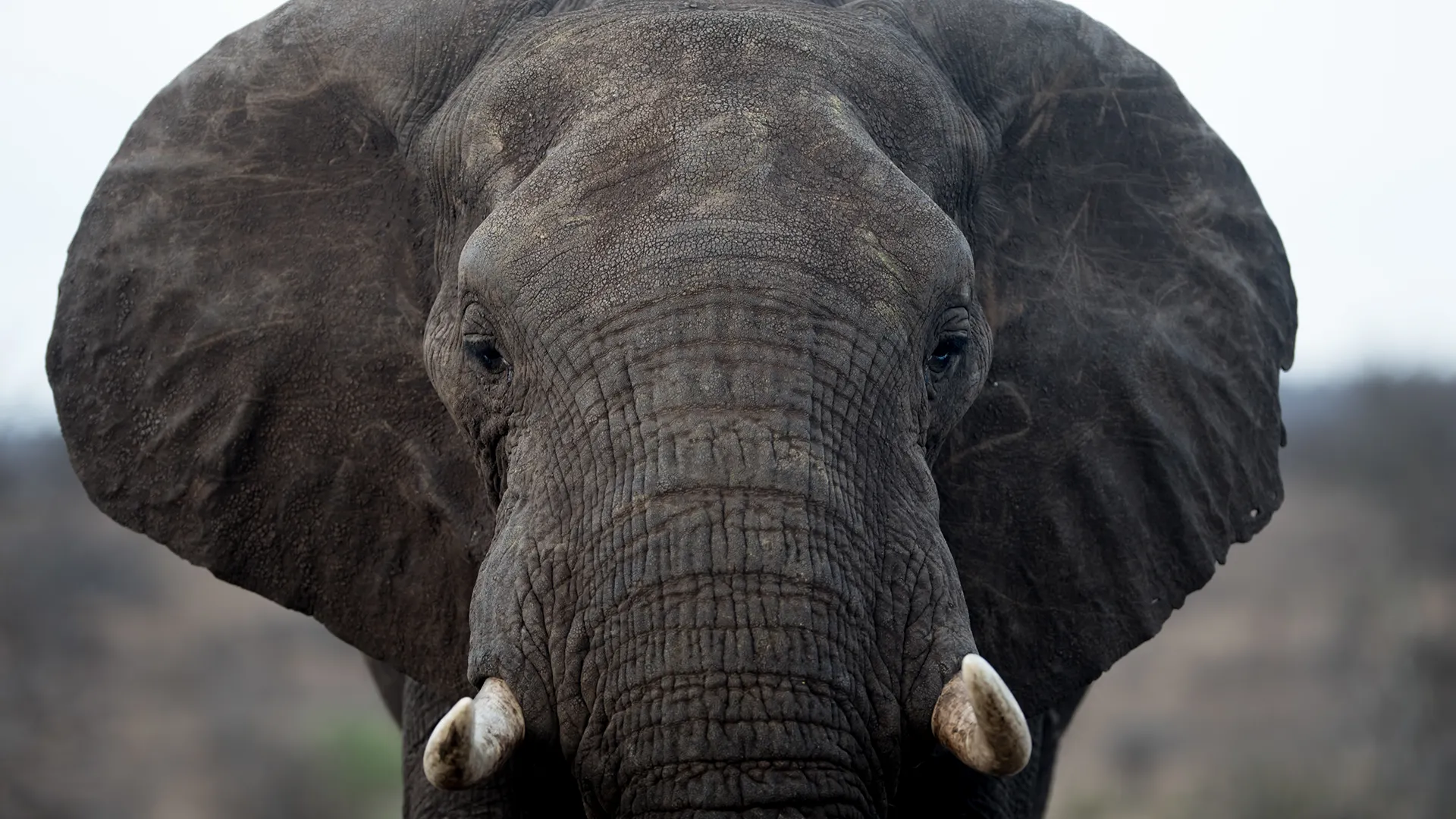
African elephants are immense, long-lived mammals with thick grey skin, pillar-like legs, large ears, a flexible trunk, and ivory tusks. Their trunk is one of the most remarkable tools in the animal world: it is used for breathing, smelling, drinking, touching, greeting, feeding, dusting, lifting, warning, and communication.
The ears of savanna elephants are especially large and help regulate body temperature. When elephants flap their ears, blood flowing through the ear tissue can release heat. Their skin is thick but sensitive, and elephants often use mud, dust, and water to protect themselves from sun, insects, and irritation.
Tusks are elongated incisor teeth. Elephants use them for digging, stripping bark, moving objects, defense, and social display. Both male and female African elephants can have tusks, although size varies by sex, age, genetics, and region.
Savanna elephants are the larger of the two African species. Adult males can weigh several tonnes, with females generally smaller. Forest elephants are more compact and adapted to closed-canopy forest, where smaller size and straighter tusks are useful.
Habitat and Distribution
African elephants live in a wide range of habitats, but they all need space, food, water, and movement corridors.
Savanna elephants occupy grasslands, floodplains, open woodlands, mopane woodland, wetlands, river systems, and semi-arid areas. They are strongly associated with major safari regions such as Botswana’s Okavango Delta and Chobe, Zimbabwe’s Hwange, Namibia’s Etosha and desert-adapted elephant landscapes, Zambia’s South Luangwa and Lower Zambezi, Tanzania’s Serengeti and Tarangire, Kenya’s Amboseli and Tsavo, South Africa’s Kruger region, and parts of Mozambique, Angola, Uganda, Rwanda, and Malawi.
Forest elephants live mainly in tropical forests of Central and West Africa, especially in the Congo Basin. They use forest clearings, mineral licks, trails, swampy areas, and fruiting-tree routes. They are harder for travelers to see because they live in dense forest and often move quietly through closed habitats.
African elephants once ranged much more widely across the continent. Today, their range is fragmented by farms, roads, settlements, fences, conflict zones, and habitat conversion.
Behavior and Social Life
African elephants have complex social lives. Female elephants usually live in family groups led by an older female, often called the matriarch. These herds are made up of related females and their calves. The matriarch’s memory of water sources, seasonal routes, danger, and social relationships can be vital to herd survival.
Young males leave the family group as they mature. Adult bulls may live alone or form loose associations with other males. Older bulls play an important social role, especially in guiding younger males and competing for access to females.
Elephants communicate through touch, scent, body posture, ear movements, trunk gestures, rumbles, trumpets, roars, and very low-frequency calls that can travel long distances. A quiet herd may still be communicating constantly through subtle signals.
Their social bonds are strong. Elephants comfort distressed companions, investigate bones, protect calves, cooperate in defense, and show clear awareness of family relationships. Calves grow up surrounded by mothers, sisters, aunts, cousins, and older females that help them learn how to live.
Diet and Feeding
African elephants are herbivores and can spend much of the day feeding. Their diet changes with season and habitat.
Savanna elephants eat grasses during wet periods and browse more heavily on leaves, bark, branches, shrubs, roots, and fruits when grass quality declines. They may dig for water, push over trees, break branches, strip bark, and open pathways through thick vegetation.
Forest elephants eat leaves, fruit, bark, seeds, and mineral-rich soil from clearings and salt licks. Because fruit is such an important part of their diet, forest elephants are major seed dispersers. They help move large seeds through the forest, supporting tree regeneration and forest diversity.
Elephants are sometimes called ecosystem engineers because their feeding and movement shape entire landscapes. In savannas, they can open woodland, create trails, dig waterholes, and influence the balance between trees and grass. In forests, they help maintain plant diversity through seed dispersal and browsing.
Reproduction and Life Cycle
African elephants reproduce slowly. Females may begin breeding from around 10 to 12 years of age, though timing depends on nutrition, population pressure, and environmental conditions. Males mature physically later and usually do not compete successfully for breeding opportunities until they are older and larger.
Gestation lasts about 22 months. A female usually gives birth to a single calf. Twins are rare. Newborn calves are vulnerable but quickly become the center of herd attention. Mothers nurse them, protect them, guide them, and keep them close.
Other females often help care for calves, a behavior known as allomothering. This gives younger females experience and improves calf safety. Calves may nurse for several years and continue learning from the herd for much longer.
Elephants can live for 60 to 70 years in the wild when conditions allow. Their slow reproduction means populations recover slowly after heavy poaching, drought, or conflict. Losing adult females, matriarchs, and breeding bulls can affect not only numbers but also social knowledge.
Taxonomy
Kingdom: Animalia
Phylum: Chordata
Class: Mammalia
Order: Proboscidea
Family: Elephantidae
Genus: Loxodonta
Species:
- Loxodonta africana – African savanna elephant.
- Loxodonta cyclotis – African forest elephant.
For many years, African elephants were often treated as one species with different forms or subspecies. Genetic and morphological research now supports recognizing savanna and forest elephants as separate species.
Conservation Status
African elephants face different but related conservation challenges across the continent.
The African savanna elephant is listed as Endangered by the IUCN Red List. The IUCN reported that savanna elephant populations declined by at least 60% over the last 50 years in the assessment used for the 2021 update.
The African forest elephant is listed as Critically Endangered. The IUCN reported a decline of more than 86% over 31 years for forest elephants, driven mainly by poaching and habitat loss.
Major threats include:
- Poaching for ivory.
- Habitat loss and fragmentation.
- Human-elephant conflict around farms and settlements.
- Loss of migration corridors.
- Retaliatory killing after crop damage or danger to people.
- Illegal wildlife trade.
- Drought, climate stress, and water scarcity.
- Conflict and weak protection in some range areas.
Conservation efforts include anti-poaching patrols, ivory trade enforcement, protected-area management, community conservancies, elephant corridors, crop-protection strategies, early-warning systems, land-use planning, and tourism models that create local value from living elephants.
Some elephant populations are stable or increasing, especially in well-protected parts of southern Africa. Others remain under severe pressure. This uneven picture is important: African elephants are not disappearing everywhere at the same rate, but both species need serious long-term protection.
Human Relationship and Responsible Travel
African elephants are among the most moving animals to see on safari, but they should never be treated casually. Their size, intelligence, family bonds, and emotional awareness make respectful viewing essential.
On game drives, stay quiet, remain seated, and allow elephants space. Never pressure a guide to drive into the middle of a herd, block a path to water, crowd calves, or push close to a bull in musth. Watch the guide’s body language and instructions carefully.
Warning signs can include head-shaking, ear-spreading, trunk-curling, dust-kicking, mock charges, rumbling, or sudden silence. A calm elephant can change quickly if it feels trapped or if calves are threatened.
Responsible travelers should support lodges, guides, and reserves that protect elephant corridors, reduce human-elephant conflict, respect distance rules, and contribute to local communities. Elephants move beyond park boundaries, so their future depends on coexistence across shared landscapes.
The African elephant is not only a safari highlight. It is a landscape-maker, a family animal, a seed carrier, a water finder, and one of the clearest measures of whether wild Africa still has enough room to breathe.