
A cheetah does not enter the landscape with the heavy authority of a lion or the shadowed secrecy of a leopard. It arrives like a line drawn through grass: lean, alert, and built for distance before speed.
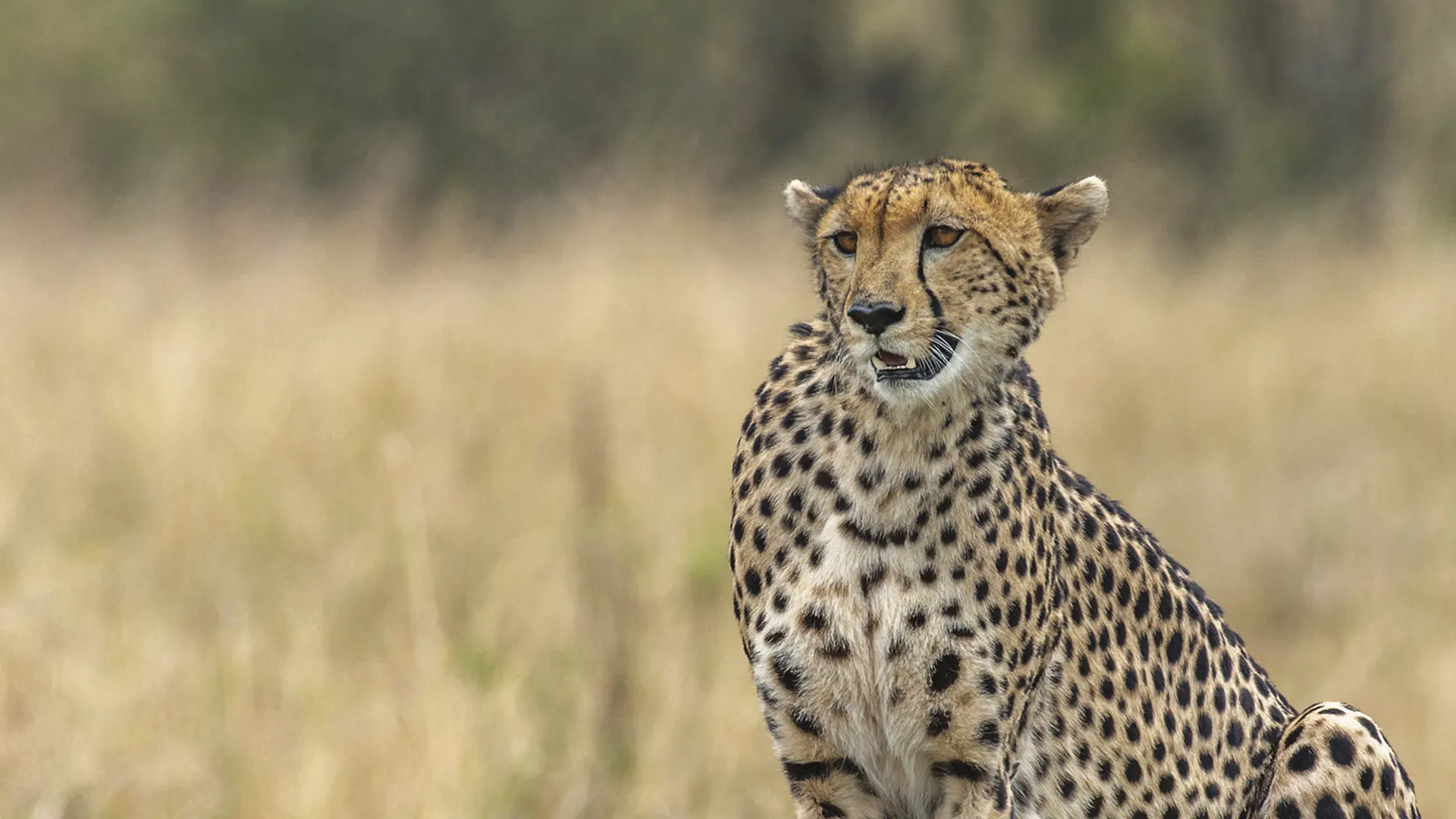
In the early morning, a cheetah may stand on a termite mound, scanning the plains with amber eyes. Its body looks almost too fine for the wild: long legs, narrow waist, small head, deep chest, and a tail made for balance. Then, when the hunt begins, the quiet animal becomes something else entirely. The spine flexes, the paws strike, the tail steers, and the fastest land mammal on Earth becomes a living expression of precision.
But the cheetah’s speed hides a fragile truth. This cat survives at low densities, loses kills to stronger predators, raises vulnerable cubs, and increasingly lives outside protected areas where it must share land with people, livestock, roads, and fences. To understand the cheetah is to see both grace and risk in the same animal.
Quick Facts
| Quick Fact | Details |
|---|---|
| Common name | Cheetah |
| Scientific name | Acinonyx jubatus |
| Animal group | Mammal, cat |
| Family | Felidae |
| Genus | Acinonyx |
| IUCN status | Vulnerable |
| Population trend | Decreasing |
| Estimated wild population | Roughly 6,500 to 7,100 individuals, depending on source and count method |
| Main range | Mostly eastern and southern Africa, with a tiny Asiatic population in Iran |
| Habitat | Grasslands, savannas, open woodland, scrub, semi-desert, and arid plains |
| Diet | Carnivore |
| Main prey | Gazelles, springbok, impala, steenbok, hares, game birds, and young antelope |
| Hunting style | High-speed pursuit after a careful stalk |
| Top speed | Often cited at around 90 to 110 km/h in short bursts |
| Social structure | Solitary females; males may be solitary or form coalitions |
| Gestation | About 90 to 95 days |
| Typical litter | Usually 3 to 5 cubs, though litter size varies |
| Main threats | Habitat loss, prey decline, conflict with people, illegal wildlife trade, low genetic diversity, and fragmented populations |
| Responsible viewing note | Keep distance, avoid pressuring resting or hunting cheetahs, and never interfere with a mother and cubs |
What Is a Cheetah?
The cheetah is a large, slender wild cat and the only living member of the genus Acinonyx. It is best known as the fastest land animal, but speed is only one part of its story. The cheetah is a specialized pursuit predator, shaped by open landscapes, alert prey, and the need to hunt in daylight while avoiding larger carnivores.
Unlike lions, leopards, jaguars, and tigers, the cheetah does not belong to the genus Panthera. It also does not roar in the same way. Cheetahs communicate with chirps, purrs, growls, hisses, yowls, and other calls, many of them surprisingly birdlike or soft for such a famous predator.
The cheetah is a cat of speed, visibility, and vulnerability. It needs space to hunt, enough prey to survive, and connected landscapes where small populations do not become isolated.
Top Questions
Yes. The cheetah is widely recognized as the fastest land mammal, capable of extraordinary acceleration and short high-speed bursts.
They are large wild cats, but they are not “big cats” in the strict Panthera sense. Cheetahs belong to their own genus, Acinonyx.
No. Cheetahs do not roar like lions or leopards. They purr, chirp, hiss, growl, yowl, and make contact calls.
Cheetahs eat mostly small to medium-sized animals, especially gazelles, springbok, impala, steenbok, hares, game birds, and young antelope.
They are threatened by habitat loss, human-wildlife conflict, prey decline, illegal cub trade, fragmented populations, and competition with larger predators.
Most wild cheetahs live in eastern and southern Africa. A very small Asiatic cheetah population survives in Iran.
General Characteristics
Cheetahs are built differently from other African cats. Their bodies are light, aerodynamic, and long-legged, with a deep chest, narrow waist, flexible spine, and small rounded head. This shape reduces weight and supports explosive acceleration.
Their coat is usually tawny or golden, marked with solid black spots. These spots help break up the body outline in grass and scrub. The face has distinctive black “tear marks” running from the inner corners of the eyes down toward the mouth. These markings may help reduce glare and are one of the easiest ways to recognize a cheetah.
The tail is long, muscular, and marked with rings near the end. During a chase, it helps with balance and steering, almost like a rudder. Cheetahs make sudden turns at high speed, and the tail helps keep the body aligned as the animal adjusts direction.
Cheetahs have semi-retractable claws, unlike most cats. Their claws give extra grip during acceleration and turning. Their paw pads are hard and ridged, helping them maintain traction on open ground.
Adult cheetahs usually weigh around 34 to 57 kg, though size varies by sex and region. Males are generally larger than females. They are tall and lean rather than heavy, built for speed rather than strength.
Habitat and Distribution
Cheetahs once ranged across much of Africa, the Middle East, and parts of Asia. Today, their range is far smaller and heavily fragmented.
Most cheetahs now live in sub-Saharan Africa, especially in eastern and southern Africa. Important range countries include Namibia, Botswana, South Africa, Zimbabwe, Zambia, Kenya, Tanzania, and parts of Angola and Mozambique. Namibia has long been one of the most important countries for cheetah conservation, partly because many cheetahs live outside formal protected areas.
A tiny Asiatic cheetah population remains in Iran. This population is critically small and isolated, making it one of the most threatened cat populations in the world.
Cheetahs use open and semi-open habitats, including grasslands, savannas, scrublands, dry plains, open woodland, and semi-desert. They often avoid dense forests because their hunting style depends on visibility, stalking room, and space for a high-speed chase.
Unlike lions and leopards, cheetahs often occur at low densities. They need large landscapes, and many live outside national parks, where they share space with livestock, farms, and human settlement.
Behavior and Social Life
Cheetah social life is unusual among cats.
Females are usually solitary, except when raising cubs. A mother may spend many months teaching her cubs how to hunt, avoid danger, and move through the landscape. Female home ranges can be large, especially where prey is scattered.
Males may live alone, but many form coalitions, often with brothers from the same litter. Male coalitions can hold territories more successfully than solitary males and may gain better access to females.
Cheetahs are mostly active during the day, especially in the cooler hours of morning and late afternoon. Daytime hunting helps them avoid some competition with lions, leopards, and hyenas, which are often more active at night. Even so, larger predators remain a serious threat. Lions and hyenas can kill cheetah cubs, steal kills, and sometimes kill adult cheetahs.
Cheetahs communicate through scent marking, urine spraying, feces, scratching, vocal calls, body posture, and facial expressions. Males may mark prominent trees, termite mounds, and other scent posts that help structure their territories.
Diet and Hunting
Cheetahs are carnivores and specialized hunters of small to medium-sized prey. Their diet varies by region but often includes gazelles, springbok, impala, steenbok, duikers, hares, game birds, and the young of larger antelope.
A cheetah hunt begins with watching. The cat scans for vulnerable prey, then stalks carefully, using grass, terrain, or low vegetation for cover. Once close enough, it launches a short, explosive chase.
The chase is fast but brief. Cheetahs cannot maintain top speed for long because the effort generates intense heat and exhaustion. If the prey is not caught quickly, the cheetah usually gives up.
During pursuit, the cheetah uses its tail to steer and its claws for grip. It may trip prey with a forepaw before killing with a throat bite. After a successful hunt, the cheetah often rests before feeding. This pause can be dangerous because lions, hyenas, leopards, or vultures may arrive and steal the kill.
Cheetahs are not built to fight larger predators. Their survival strategy is speed, caution, and avoidance.
Reproduction and Life Cycle
Cheetahs can breed throughout the year. Males and females come together briefly to mate, then separate. The female raises the cubs alone.
Gestation lasts about 90 to 95 days. A typical litter has three to five cubs, though litter size can vary. Cubs are born small, blind, and vulnerable, usually hidden in dense grass, shrubs, or other cover.
Young cheetah cubs have a pale, mantle-like strip of longer fur along the back. This may help camouflage them in grass and may also make them look less like vulnerable cat cubs from a distance.
Cub mortality is high. Lions, hyenas, leopards, eagles, snakes, disease, fire, starvation, and abandonment can all threaten young cheetahs. The mother must hunt regularly while also moving cubs between hiding places to reduce the risk of discovery.
Cubs begin following their mother after the earliest denning period and gradually learn stalking and hunting skills. They may stay with her for around 18 months or more. After independence, littermates may remain together for a time before females disperse and males either separate or form coalitions.
Taxonomy
Kingdom: Animalia
Phylum: Chordata
Class: Mammalia
Order: Carnivora
Family: Felidae
Genus: Acinonyx
Species: Acinonyx jubatus
Commonly discussed cheetah subspecies include:
| Subspecies | Common Description | Main Region |
|---|---|---|
| Acinonyx jubatus jubatus | Southeast African cheetah | Southern Africa |
| Acinonyx jubatus soemmeringii | Northeast African cheetah | Northeast Africa |
| Acinonyx jubatus hecki | Northwest African cheetah | Northwest Africa and Sahara region |
| Acinonyx jubatus venaticus | Asiatic cheetah | Iran |
Taxonomy can be revised as genetic research improves, so detailed publication work should check the latest IUCN and Cat Specialist Group treatments.
Conservation Status
The cheetah is listed as Vulnerable on the IUCN Red List, and its population trend is decreasing. Current conservation sources estimate roughly 6,500 to 7,100 wild cheetahs, depending on the source and method used.
The species has disappeared from most of its historic range. Panthera notes that cheetahs occupy only a small fraction of their former distribution, and WWF gives an estimate of about 6,500 individuals. The remaining populations are often small, scattered, and vulnerable to local extinction.
Major threats include:
- Habitat loss and fragmentation.
- Decline of wild prey.
- Conflict with livestock farmers.
- Illegal trade in live cubs.
- Road deaths and fencing impacts.
- Loss of movement corridors.
- Competition with lions, hyenas, and leopards.
- Small isolated populations.
- Low genetic diversity.
- Climate and drought pressure in some regions.
Cheetah conservation often happens outside traditional national parks because many cheetahs live on community land, private farmland, conservancies, and mixed-use landscapes. This makes coexistence essential.
Effective conservation includes livestock protection, guard dogs, better herding practices, compensation or incentive programs, anti-trafficking work, habitat corridors, prey recovery, community conservancies, and careful monitoring of small populations.
Human Relationship and Responsible Viewing
Cheetahs are among the most desired safari sightings because they are elegant, visible, and sometimes active in daylight. But they are also easily pressured.
A responsible cheetah sighting should be calm. Vehicles should not crowd the animal, block its route, separate a mother from cubs, or interfere with a hunt. If a cheetah is stalking prey, guides and visitors should give it space and avoid changing the behavior of either predator or prey.
Extra care is needed around mothers with cubs. Cheetah cubs are vulnerable, and a stressed mother may move them more often than she should, increasing risk. Travelers should keep voices low, remain seated, and follow guide instructions.
Cheetahs should never be baited, chased, called, or handled for tourism. Facilities offering direct contact, cub petting, or photo sessions with captive cheetahs should be treated with caution. Ethical conservation focuses on wild populations, habitat, anti-trafficking work, and science-led care where captivity is genuinely necessary.
A good cheetah sighting leaves the cat in control of its day.
Final Reflection
The cheetah is often described through speed, but speed alone does not explain it. The cheetah is patience before movement, silence before acceleration, and vulnerability behind elegance. It survives not by overpowering the wild, but by reading it carefully.
To watch a cheetah well is to notice the stillness before the sprint: the lifted head, the focused eyes, the wind direction, the distance to prey, the risk of lions nearby. In that moment, the fastest land animal is also one of the most delicate measures of whether open landscapes still have room for wild life to continue.