
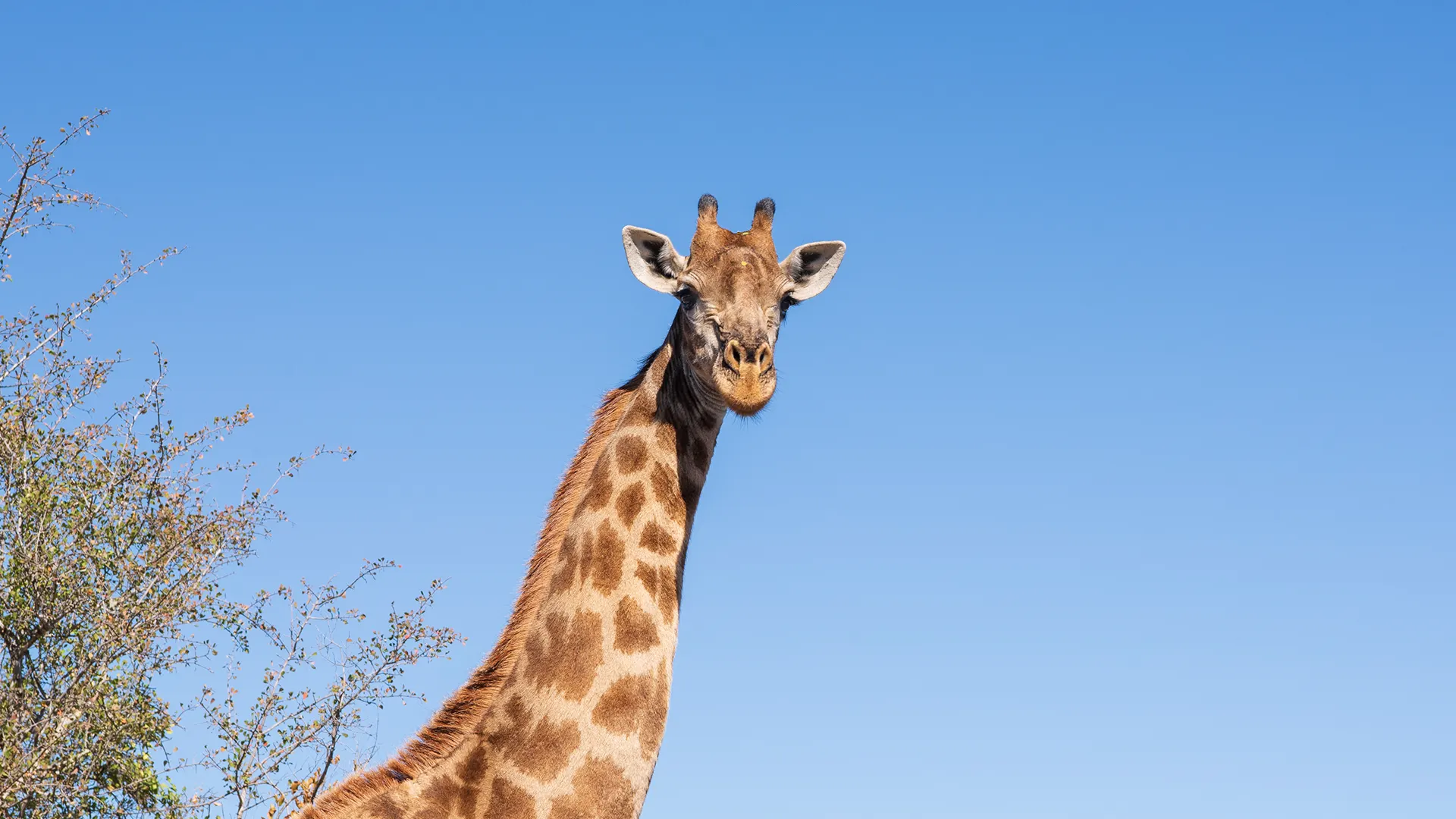
A giraffe changes the scale of the savanna.
Before you notice its full body, you may see the head first, moving above thorn trees like a quiet lookout. Then the rest of the animal resolves into view: long legs, patterned coat, sloping back, calm eyes, and a neck that seems to belong to the horizon itself. A giraffe feeding among acacias does not rush the landscape. It studies it from above.
Yet this height should not make the giraffe feel distant. Giraffes are social, watchful, vulnerable animals shaped by open woodland, browsing routes, seasonal food, and the constant need to see danger before danger gets close. Their decline across parts of Africa has often been called a “silent extinction” because it happened with less attention than the losses of elephants, rhinos, and big cats. To understand the giraffe is to look up, then look closer.
Quick Facts Table
| Quick Fact | Details |
|---|---|
| Common name | Giraffe |
| Scientific name | Traditionally Giraffa camelopardalis; current taxonomy increasingly recognizes multiple giraffe species |
| Animal group | Mammal, hoofed ruminant |
| Family | Giraffidae |
| Closest living relative | Okapi |
| IUCN status | Vulnerable under the traditional one-species assessment; individual species/subspecies range from Least Concern to Critically Endangered |
| Population trend | Declined significantly over recent decades, though some populations are improving |
| Estimated population | Giraffe Conservation Foundation estimates about 117,000 giraffes in the wild |
| Main range | Fragmented populations across sub-Saharan Africa |
| Habitat | Savannas, open woodlands, wooded grasslands, shrublands, and semi-arid landscapes |
| Diet | Herbivore, mainly browser |
| Main food | Leaves, shoots, flowers, fruits, and twigs, especially from acacia and related trees |
| Height | Up to about 5.5 m |
| Distinctive features | Long neck, long legs, ossicones, spotted coat, long tongue |
| Social structure | Loose, changing groups often called towers |
| Gestation | About 15 months |
| Typical young | One calf |
| Main predators | Lions; calves may be taken by hyenas, leopards, and wild dogs |
| Main threats | Habitat loss, illegal hunting, civil unrest, climate pressure, fragmentation, and ecological change |
| Responsible viewing note | Give giraffes space, avoid blocking movement, and never pressure them into running |
What Is a Giraffe?
A giraffe is a tall African browsing mammal in the family Giraffidae. It is the tallest land animal alive today and the largest ruminant, meaning it has a specialized multi-chambered stomach for digesting plant material.
Giraffes are best known for their long necks, but their bodies are full of specialized adaptations: long legs for stride and visibility, a prehensile tongue for feeding, ossicones on the head, a powerful heart for pumping blood upward, and a patterned coat that can help break up their outline among trees.
For many years, giraffes were commonly treated as one species, Giraffa camelopardalis, with several subspecies. Recent genetic research supports a more complex picture, and many conservation groups now discuss four giraffe species. Taxonomy is still an active area of research, so guide pages should be clear about which system they are using.
Top Questions
Giraffes are listed as Vulnerable under the traditional one-species IUCN assessment, but some types of giraffe are much more threatened than others. Nubian and Kordofan giraffes are among the most threatened.
Adult giraffes can stand up to about 5.5 meters tall. Males are usually taller and heavier than females.
Their long necks help them browse high leaves, watch for danger, and compete in male dominance contests known as necking.
Giraffes are browsers. They mainly eat leaves, shoots, flowers, fruits, and twigs from trees and shrubs, especially acacias.
They can rest while standing, but they may also lie down. Giraffes generally sleep in short periods because they must remain alert to predators.
A baby giraffe is called a calf.
General Characteristics
Giraffes have a body shape unlike any other living land animal. Their front legs are slightly longer than their back legs, giving the back a sloping appearance. Their necks are long, but like most mammals, giraffes have seven neck vertebrae; each vertebra is simply greatly elongated.
The head carries horn-like structures called ossicones. These are not true horns in the same way as antelope horns. Ossicones are skin-covered bony structures, present in both males and females. Males often develop thicker, more worn ossicones from fighting.
A giraffe’s coat pattern is made of irregular patches separated by lighter lines. The exact pattern varies by species, subspecies, region, and individual. Like fingerprints, coat patterns can help researchers identify individuals.
Their tongues are long, dark, and muscular, often around 45 cm in length. The tongue and flexible lips help giraffes strip leaves from thorny branches. Their saliva is thick, which may help protect the mouth while feeding on spiny plants.
Giraffes walk with a pacing gait, moving both legs on the same side of the body together. When running, they use a galloping motion, with the neck helping balance the movement.
Habitat and Distribution
Giraffes live across parts of sub-Saharan Africa, but their range is fragmented. They occupy savannas, open woodlands, wooded grasslands, shrublands, dry bush, and semi-arid areas where browsing trees and shrubs are available.
They are especially associated with acacia, commiphora, terminalia, and other browse-rich trees. They generally avoid dense rainforest and true desert, although some populations live in very dry landscapes where enough food and water are available.
Important giraffe landscapes include northern Namibia, Botswana, South Africa, Zimbabwe, Zambia, Tanzania, Kenya, Uganda, Niger, Chad, Ethiopia, and parts of other eastern, central, and southern African countries.
Giraffes have disappeared from parts of their former range. Habitat conversion, fencing, farming, settlement expansion, illegal hunting, and insecurity have all reduced where giraffes can live safely.
Behavior and Social Life
Giraffe society is flexible. They live in loose, changing groups rather than tightly bonded herds. These groups are often called towers, though individuals may join, leave, and rejoin different groups over time.
Females with calves may gather in nursery groups, where several young giraffes stay near adult females. Males often range more widely, especially as they mature and search for mating opportunities.
Male giraffes establish dominance through a behavior called necking. During necking, males swing their necks and heads at one another, striking with the ossicones. Some contests are ritualized and mild, while others can be forceful.
Giraffes communicate through body posture, scent, touch, visual signals, and low-frequency sounds. Much of their social life is subtle: orientation, spacing, watching, following, and quiet contact between mothers and calves.
Their height gives them a strong advantage in predator detection. Other animals may respond when giraffes stare intently in one direction, because a giraffe’s attention can signal lions or other danger nearby.
Diet and Feeding
Giraffes are herbivores and primarily browsers. They feed mostly on leaves, shoots, flowers, seed pods, fruits, and twigs from trees and shrubs.
Acacias are especially important in many giraffe habitats. Giraffes use their long tongues and flexible lips to pull leaves between thorns. Their height allows them to feed above the reach of many other herbivores, reducing direct competition.
Giraffes may also feed on shrubs, vines, and occasional grasses, depending on season and habitat. During dry periods, evergreen trees and deep-rooted browse can be critical food sources.
Because giraffes browse high branches and move seeds through their digestive system, they influence vegetation structure and may help with seed dispersal. Their feeding can shape tree growth, especially in areas with high giraffe densities.
Reproduction and Life Cycle
Giraffes can breed throughout the year, though births may peak in certain seasons depending on region and rainfall.
Males assess female reproductive condition by smelling and tasting urine, using a flehmen response. Dominant adult males are more likely to mate, though mating systems are not based on permanent pair bonds.
Gestation lasts about 15 months. A female usually gives birth standing up, and the calf drops to the ground at birth. This fall sounds dramatic, but it helps break the umbilical cord and stimulate breathing.
Newborn calves are already tall, often around 1.5 to 2 meters. They can usually stand and walk within a short time, which is essential in predator country.
Calves are vulnerable to lions, hyenas, leopards, wild dogs, and crocodiles in some areas. Mothers defend calves with powerful kicks, and an adult giraffe’s kick can seriously injure or kill a predator.
Young giraffes nurse for months and gradually increase browsing. Females may remain near their birth area, while males often disperse more widely as they mature.
Taxonomy
Kingdom: Animalia
Phylum: Chordata
Class: Mammalia
Order: Artiodactyla
Family: Giraffidae
Genus: Giraffa
Traditional taxonomy often treats giraffes as one species:
| Traditional Species | Scientific Name |
|---|---|
| Giraffe | Giraffa camelopardalis |
A widely used modern conservation framework recognizes four giraffe species:
| Species | Scientific Name | General Region |
|---|---|---|
| Northern giraffe | Giraffa camelopardalis | West, Central, and parts of East Africa |
| Reticulated giraffe | Giraffa reticulata | Horn of Africa and northern Kenya region |
| Masai giraffe | Giraffa tippelskirchi | Kenya and Tanzania |
| Southern giraffe | Giraffa giraffa | Southern Africa |
Because giraffe taxonomy continues to be refined, conservation status can look different depending on whether the guide uses the one-species model or the multi-species model.
Conservation Status
Giraffe conservation is more serious than many travelers realize. Under the traditional one-species IUCN assessment, giraffes are listed as Vulnerable. However, some giraffe species and subspecies are in much deeper trouble.
The Giraffe Conservation Foundation estimates that about 117,000 giraffes remain in the wild. It also notes that giraffe numbers have declined by nearly 30% over the past 35 years, and that giraffes have lost almost 90% of their historical range over the last three centuries.
Threat levels vary by region. Some southern giraffe populations are stable or increasing due to conservation action, translocations, and protected-area management. Other populations, especially in parts of West, Central, and East Africa, have declined sharply.
Major threats include:
- Habitat loss and fragmentation.
- Conversion of land for agriculture and settlement.
- Illegal hunting for meat, hides, tails, and other body parts.
- Civil unrest and weak protection in some range areas.
- Climate pressure, drought, and ecological change.
- Fencing and barriers to natural movement.
- Small isolated populations.
- Disease risk in some local populations.
Conservation work includes habitat protection, anti-poaching patrols, community conservation, translocations, long-term monitoring, genetic research, protected corridors, and stronger public awareness.
Human Relationship and Responsible Travel
Giraffes are often calm around vehicles, but they still deserve space and respect. Their quiet behavior can make travelers underestimate their sensitivity.
On safari, vehicles should not block a giraffe’s path, force it to run, cut between a mother and calf, or crowd animals at waterholes. A running giraffe is beautiful to watch, but making one run for a photograph is poor guiding and poor travel behavior.
The best giraffe sightings come from patience: watching how they browse around thorns, how oxpeckers move across their necks, how calves stay close to mothers, and how an entire group suddenly freezes when something catches their attention.
Travelers can support giraffe conservation by choosing responsible operators, respecting protected-area rules, avoiding products made from wildlife parts, and learning which giraffe species or subspecies live in the destination they are visiting.
A good giraffe encounter lets the animal remain exactly what it is: tall, watchful, unhurried, and wild.
Final Reflection
The giraffe is easy to recognize and easy to underestimate. Its height makes it famous, but its survival depends on the ground beneath it: trees, corridors, water, safety, and enough connected land to move through seasons.
To watch a giraffe well is to see more than a long neck. It is to notice the browsing line in the trees, the calf stepping carefully through grass, the bull testing another male, and the way one raised head can change the attention of every animal nearby.
The giraffe belongs to the open African horizon, but its future will be decided by close, practical choices: land use, protection, coexistence, and whether people notice the silent losses before they become permanent.