
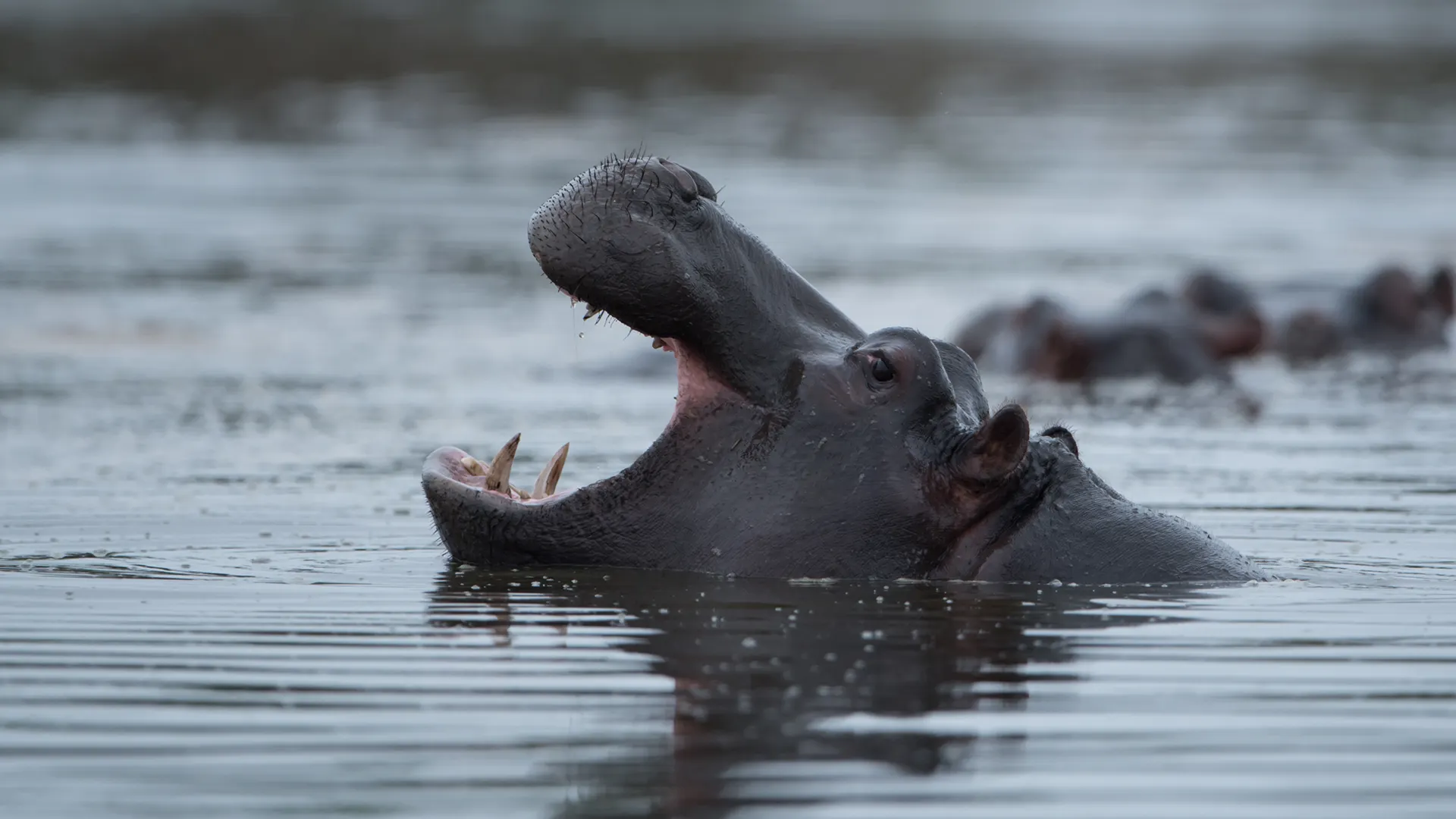
A hippopotamus is often first seen as a shape in water: nostrils, ears, and eyes resting just above the surface while the rest of the body disappears below. It can look almost still, like a river stone with breath.
Then the water shifts. A jaw opens. A low call rolls across the channel. Another hippo answers from the far bank, and the quiet pool becomes a living territory.
The hippopotamus is one of Africa’s most familiar animals, but also one of the most misunderstood. It is not slow in the way people imagine. It is not harmless because it eats grass. It is a massive, territorial, semi-aquatic mammal that spends the day in water and comes ashore at night to graze. In the right light, a hippo is almost peaceful. In the wrong distance, it is one of the most dangerous animals a traveler can meet.
To understand the hippopotamus is to understand the relationship between water, grass, territory, and power.
Quick Facts Table
| Quick Fact | Details |
|---|---|
| Common name | Hippopotamus |
| Also known as | Common hippopotamus, river hippo, hippo |
| Scientific name | Hippopotamus amphibius |
| Meaning of name | From Greek roots often translated as “river horse” |
| Animal group | Mammal |
| Family | Hippopotamidae |
| Closest living relatives | Cetaceans, including whales and dolphins |
| IUCN status | Vulnerable |
| Population trend | Generally considered decreasing or regionally uncertain |
| Main range | Sub-Saharan Africa |
| Habitat | Rivers, lakes, wetlands, floodplains, swamps, and nearby grasslands |
| Diet | Herbivore |
| Main food | Short grasses and other vegetation, mostly grazed at night |
| Weight | Often 1,300 to 3,200 kg; large males can be heavier |
| Shoulder height | Around 1.3 to 1.6 m |
| Social structure | Groups in water, usually with territorial adult males and females with young |
| Gestation | About 8 months |
| Typical young | One calf |
| Lifespan | Around 40 to 50 years |
| Main threats | Habitat loss, hunting, conflict with people, water pressure, drought, and illegal trade in teeth |
| Responsible viewing note | Keep a safe distance from water edges, never block a hippo’s path, and avoid moving between a hippo and water |
What Is a Hippopotamus?
The hippopotamus is a large semi-aquatic mammal native to sub-Saharan Africa. The species most people know is the common hippopotamus, Hippopotamus amphibius. It is one of two living hippo species; the other is the much smaller pygmy hippopotamus of West African forests.
Despite its nickname “river horse,” the hippo is not closely related to horses. Its closest living relatives are cetaceans, the group that includes whales, dolphins, and porpoises. This relationship may seem surprising at first, but hippos and cetaceans share deep evolutionary ancestry.
The common hippopotamus is among the heaviest land mammals, after elephants and rhinoceroses. It is built for life between water and land: submerged by day, grazing by night, and constantly tied to rivers, pools, lakes, and floodplains.
Top Questions
Are hippos dangerous?
Yes. Hippos are powerful, territorial, and can be highly dangerous, especially near water, calves, narrow paths, or when surprised.
Do hippos eat meat?
Hippos are mainly herbivores and graze mostly on grasses. Rare cases of scavenging or meat-eating have been recorded, but this is not their normal diet.
Can hippos swim?
Hippos spend much of the day in water, but they do not swim like many people imagine. They often walk, push off, or bounce along the bottom in shallow water.
Why do hippos stay in water?
Water helps keep them cool and protects their sensitive skin from sun and heat.
How long can hippos stay underwater?
Hippos can remain submerged for several minutes, often around five minutes, before surfacing to breathe.
Are hippos related to pigs?
They may look somewhat pig-like, but their closest living relatives are whales and dolphins.
General Characteristics
The hippopotamus has a barrel-shaped body, short legs, a massive head, thick neck, large mouth, and powerful jaws. Its body is adapted for strength and buoyancy rather than elegance on land, but it can still move quickly over short distances.
The eyes, ears, and nostrils sit high on the head. This allows a hippo to stay mostly underwater while still seeing, hearing, and breathing. The nostrils and ears can close when submerged.
Hippo skin is thick but sensitive. It dries and cracks if exposed too long to sun, which is why hippos spend much of the day in water or mud. Their skin secretes a reddish oily substance sometimes called “blood sweat,” though it is not blood and not true sweat. This secretion helps protect the skin and may have antibacterial and sun-screening properties.
Their canine and incisor teeth can be enormous. These teeth are used mainly for fighting and display, not grazing. The wide yawn of a hippo is often a threat display, showing size, teeth, and dominance.
Males are usually larger than females and continue growing for much of their lives. A large bull can be an imposing presence, especially when defending a stretch of water.
Habitat and Distribution
Hippos live in sub-Saharan Africa, where they are closely associated with freshwater systems. They need permanent or seasonal access to rivers, lakes, pools, wetlands, swamps, floodplains, or reservoirs deep enough to rest in during the day.
At night, they leave the water to graze, often following regular paths to feeding areas. These trails can become deeply worn through repeated use and may be visible around riverbanks and floodplains.
Hippos once occupied a wider African range, including parts of the Nile system where they are now absent or rare. Today, they are mostly found in protected areas and suitable river systems across eastern, central, western, and southern Africa.
Important viewing regions include the Okavango Delta, Chobe River, South Luangwa, Lower Zambezi, Luangwa Valley, Murchison Falls, Queen Elizabeth National Park, Serengeti and Grumeti river systems, Selous/Nyerere, Kruger, iSimangaliso, and many major African river corridors.
Their distribution is limited by water availability, human pressure, hunting, agriculture, dams, and conflict around shared river systems.
Behavior and Social Life
Hippos are social in water but feed mostly alone at night. Daytime groups may include females, calves, younger animals, and a dominant territorial male. These groups are sometimes called pods, schools, bloats, or herds.
A bull may defend a stretch of riverbank, pool, or lake edge. His territory is usually tied to water, not grazing land. Females may move through or rest within these territories, while rival males are challenged or driven away.
Hippos communicate with grunts, wheezes, honks, bellows, roars, splashes, dung scattering, body posture, and open-mouth displays. Their calls can carry across water, and they are known for vocalizing both above and below the surface.
Dominance disputes can be intense. Males may clash using their large jaws and teeth, causing serious wounds. Many adult males carry scars from fights.
Although they often rest close together, hippos are not gentle herd animals in the same way as antelope or buffalo. Their social life is built around water access, mating rights, calf protection, and space.
Diet and Grazing
Hippos are mainly grazers. They leave the water after sunset and feed on land, usually cropping short grasses with their wide lips. A hippo may travel several kilometers in a night to graze, depending on food availability and local conditions.
Despite their size, hippos do not eat as much as might be expected compared with some other large herbivores. Their slow daytime metabolism and resting behavior help conserve energy.
Hippos play an important ecological role by moving nutrients between land and water. They graze on land at night, then return to water during the day, where their dung adds organic material to aquatic systems. In balanced numbers, this can support fish, insects, and nutrient cycling. In crowded or stressed systems, too much dung can affect water quality.
Their grazing also creates paths and short-grass areas used by other animals.
Reproduction and Life Cycle
Hippos usually mate in water. Gestation lasts about 8 months, and a female gives birth to a single calf, often in shallow water or a quiet sheltered area.
A newborn calf can nurse underwater, surfacing to breathe as needed. The mother is highly protective, and a cow with a calf should be given exceptional space.
Calves may rest on the mother’s back in water and stay close during the early months of life. They begin grazing gradually but continue nursing for many months. Young hippos face threats from crocodiles, lions, hyenas, and aggressive adult hippos, though the mother’s protection is strong.
Females may reproduce every couple of years when conditions are good. Because hippos reproduce slowly, heavy hunting or repeated conflict deaths can reduce local populations over time.
Taxonomy
Kingdom: Animalia
Phylum: Chordata
Class: Mammalia
Order: Artiodactyla
Family: Hippopotamidae
Genus: Hippopotamus
Species: Hippopotamus amphibius
The common hippopotamus belongs to the family Hippopotamidae, which today includes only two living species:
| Species | Scientific Name | Main Region |
|---|---|---|
| Common hippopotamus | Hippopotamus amphibius | Sub-Saharan Africa |
| Pygmy hippopotamus | Choeropsis liberiensis | West African forests |
The pygmy hippo is smaller, more forest-adapted, and less aquatic than the common hippo.
Conservation Status
The common hippopotamus is listed as Vulnerable on the IUCN Red List. Population status varies by country and river system. Some protected populations are stable or locally secure, while others are declining or poorly known.
Major threats include:
- Habitat loss and degradation.
- Conflict with people around rivers, farms, and fishing areas.
- Hunting for meat.
- Illegal trade in hippo teeth as ivory substitutes.
- Water extraction and changing river flows.
- Drought and climate stress.
- Wetland conversion.
- Mining and water pollution.
- Local insecurity and weak enforcement in some range areas.
Hippos need both water and grazing land. Protecting only the river channel is not enough if the surrounding night-feeding areas are converted to farms, fenced off, or heavily disturbed.
Conservation requires protected wetlands, river corridor management, anti-poaching work, conflict reduction, careful water planning, and community engagement in places where people and hippos share the same resources.
Human Relationship and Responsible Travel
Hippos demand respect. Many dangerous encounters happen when people underestimate them, approach too closely, or accidentally block their route between water and grazing areas.
On safari, travelers should keep a safe distance from riverbanks, channels, boat routes, and hippo paths. Never stand between a hippo and water. Never approach calves. Never assume a submerged hippo is relaxed simply because it is still.
Boat safaris require special care. A guide should understand hippo behavior, avoid tight channels where animals feel trapped, and give bulls enough space. Hippos may surface suddenly, lunge, or charge boats if they feel threatened.
On land, hippos can move quickly over short distances. Nighttime walking near rivers or lakes in hippo country is dangerous without expert local guidance.
Responsible viewing means quiet observation, distance, and patience. A good hippo sighting may include mothers and calves resting in water, bulls calling from river bends, birds walking along backs, or grazing trails leading from the bank into moonlit grass.
Final Reflection
The hippopotamus belongs to the edge between land and water. It grazes under darkness, rests under the river surface, and shapes both banks and channels through its daily movement.
It is easy to reduce the hippo to size and danger, but that misses the deeper story. A hippo is a grazer, a nutrient carrier, a territorial river animal, a mother guarding a calf, and a sign of whether wetlands are still healthy enough to hold large life.
To watch a hippopotamus well is to respect the water it owns, the paths it follows, and the strength it does not need to prove unless something comes too close.