
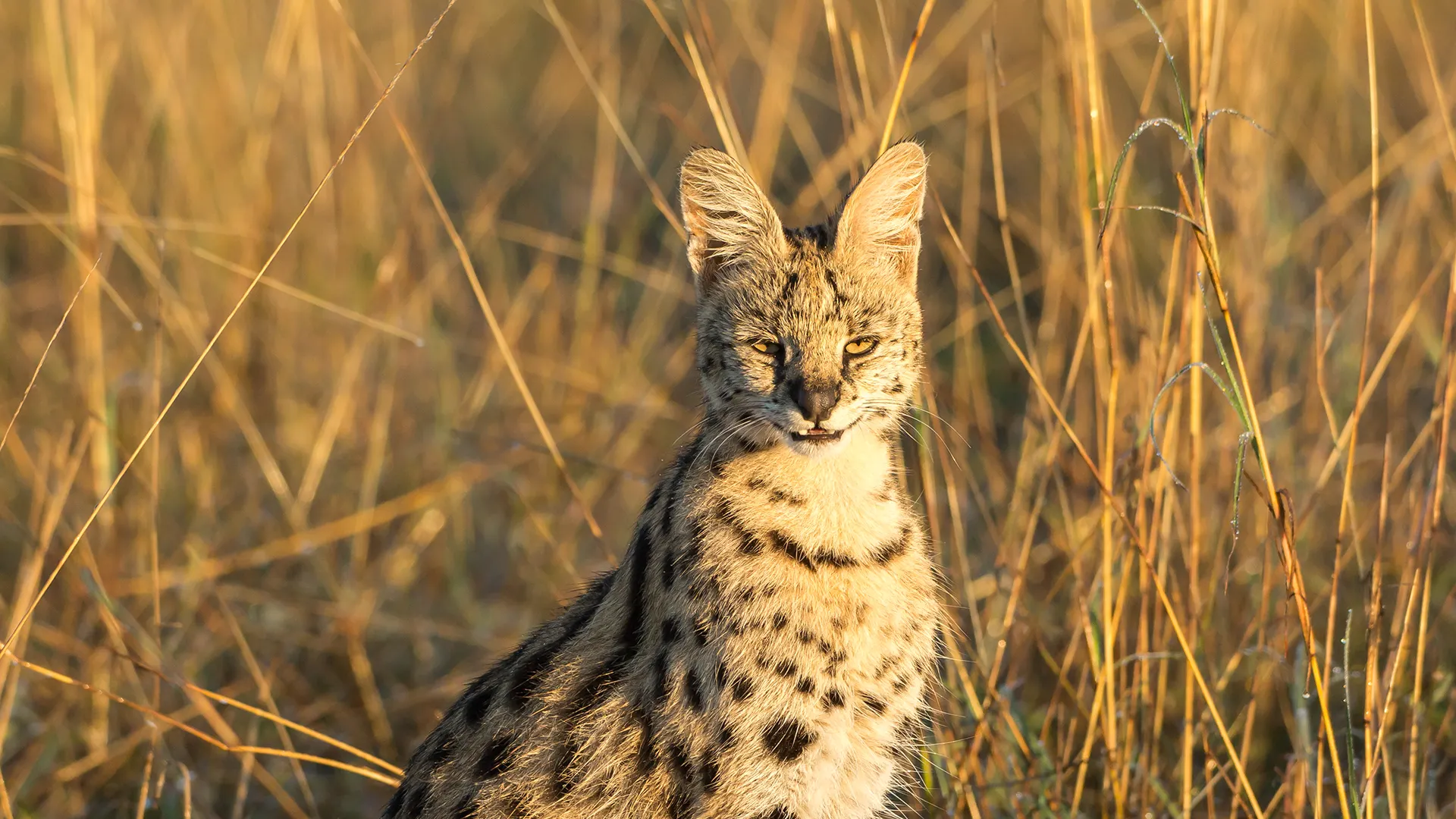
A serval is built for listening.
It may appear at the edge of wet grass just after sunrise, tall-legged and still, with ears lifted like twin dishes above a small, elegant head. The body is golden, spotted, and lean, but the ears are what hold the attention. They turn, tilt, pause, and measure the world.
Then the cat springs. A serval does not simply chase prey across the ground. It rises, folds, and drops with both front paws aimed at one exact place in the grass. For a moment, the hunter disappears into reeds or sedge, and when it lifts its head again, the landscape feels sharper.
The serval is one of Africa’s most specialized small cats: a wetland hunter, a rodent specialist, a high jumper, and a quiet sign of healthy grassland and marsh habitat.
Quick Facts Table
| Quick Fact | Details |
|---|---|
| Common name | Serval |
| Scientific name | Leptailurus serval |
| Animal group | Mammal, wild cat |
| Family | Felidae |
| Genus | Leptailurus |
| IUCN status | Least Concern |
| Population trend | Stable globally, though local populations can decline |
| Main range | Sub-Saharan Africa, with limited North African records and reintroductions |
| Habitat | Wetlands, marsh edges, reedbeds, grasslands, savannas, moorlands, and open woodland near cover |
| Diet | Carnivore |
| Main prey | Rodents, shrews, birds, frogs, reptiles, insects, hares, and occasionally small antelope |
| Hunting style | Listening, stalking, and high vertical pounces |
| Distinctive features | Very large ears, long legs, spotted coat, small head, short tail |
| Social structure | Mostly solitary |
| Activity pattern | Active by day and night, often around dawn, dusk, night, and cool or wet periods |
| Gestation | About 74 days |
| Typical litter | Usually 1 to 3 kittens |
| Lifespan | Around 10 years in the wild; longer in managed care |
| Main threats | Wetland loss, grassland degradation, hunting, skin trade, road deaths, and conflict with poultry or small livestock owners |
| Responsible viewing note | Keep distance, avoid flushing servals from cover, and never pressure a hunting cat for a photograph |
What Is a Serval?
The serval is a medium-sized African wild cat and the only living species in the genus Leptailurus. Its scientific name is Leptailurus serval.
It is smaller than a leopard but taller and longer-legged than many other small cats. The serval’s body is highly specialized for hunting in tall grass, wetland edges, and open cover. Its long legs raise it above vegetation, its large ears help locate hidden prey, and its explosive leap allows it to catch animals concealed beneath grass or reeds.
Servals are sometimes mistaken for young leopards because of their spotted coats, but they are very different cats. A serval has a smaller head, much larger ears, a shorter tail, a lighter frame, and a more upright, spring-loaded posture.
Top Questions
No. The serval is a medium-sized wild cat, not a big cat like a lion, leopard, or tiger.
Servals live mainly in sub-Saharan Africa, especially in grasslands, wetlands, savannas, reedbeds, and open habitats with cover and water nearby.
Servals mostly eat rodents, but they also hunt birds, frogs, reptiles, insects, shrews, hares, and occasionally small antelope.
Their large ears help them detect small prey moving under grass, soil, reeds, or leaf litter.
Yes. Servals are famous for vertical leaps used to catch birds or land precisely on hidden prey.
Globally, servals are listed as Least Concern, but local populations can decline where wetlands and grasslands are degraded or where they are hunted.
General Characteristics
Servals have one of the most distinctive body shapes of any wild cat. They are slender, long-legged, deep-chested, and narrow-bodied, with a small head and very large rounded ears. Their legs are the longest of any cat relative to body size, giving them height and reach in tall vegetation.
Their coat is usually golden-yellow, tawny, or buff, marked with black spots and stripes. The pattern varies by individual and region. Some servals have larger spots, while others show finer markings. Melanistic servals, which appear dark or black, occur rarely, especially in some highland areas.
The ears are a central part of serval identity. They are large, mobile, and sensitive, allowing the cat to hear small prey moving in grass or underground. The back of each ear is dark with a pale central mark, a feature common in many cats.
Adult servals usually weigh about 7 to 18 kg, with males generally larger than females. They stand tall for their weight, often appearing elegant and high-shouldered.
The tail is relatively short compared with many cats. This suits the serval’s hunting style, which depends more on vertical pouncing, listening, and quick strikes than long tree climbing or extended chases.
Habitat and Distribution
Servals are native to Africa and are most widespread south of the Sahara. They are strongly associated with habitats that combine cover, small prey, and water.
They often live in wetlands, marsh edges, reedbeds, floodplains, moist grasslands, savannas, open woodland, moorlands, bamboo thickets, and high-altitude grasslands. They usually avoid dense rainforest and very dry desert.
Servals are often linked to water because wetlands support the rodents, frogs, birds, and other small animals they hunt. Reedbeds and tall grasses also give them cover for stalking and resting.
They occur across many African countries, especially in eastern, central, and southern Africa. Important viewing regions include parts of Botswana, Zambia, Tanzania, Kenya, Uganda, South Africa, Rwanda, Zimbabwe, Namibia, and Ethiopia, though sightings are always less predictable than those of larger animals.
In North Africa, servals are rare. They are known historically from Morocco and have been reintroduced in Tunisia, while their status in some former areas is uncertain.
Behavior and Social Life
Servals are mostly solitary. Adult males and females maintain home ranges that may overlap, but they usually come together only for mating. The strongest social bond is between a mother and her kittens.
They mark their ranges with urine spraying, feces, scent rubbing, and scratch marks. Like many cats, they use scent as a quiet map of who has passed through an area and when.
Servals can be active by day or night depending on local conditions. Activity often increases around dawn, dusk, night, cool weather, and rainy periods, when prey is easier to find and heat stress is lower.
A serval’s movements are careful and attentive. It may walk slowly through grass, pause for long stretches, tilt its ears, and then pounce suddenly. It can also leap to catch birds in flight or jump down hard onto prey hidden beneath vegetation.
Servals can purr, hiss, growl, cackle, meow, and make high-pitched calls. They are usually shy around people and larger predators, using cover and quick movement to avoid danger.
Diet and Hunting
Servals are carnivores and rodent specialists. In many areas, rodents make up most of their diet, especially vlei rats and other grassland or wetland species. This makes servals important natural controllers of small mammal populations.
Their diet also includes shrews, hares, frogs, lizards, snakes, insects, crabs, small birds, waterbirds, and occasionally young antelope or other small mammals.
The serval’s hunting method is built around hearing. It may stand still for several minutes, ears turning independently, listening for movement in grass. Once it locates prey, it stalks carefully and then leaps high before dropping with its front paws onto the target.
This pouncing style is highly effective. Studies from areas such as Ngorongoro have shown servals can have unusually high hunting success compared with many other cats, although success varies by prey, habitat, and conditions.
Servals may also dig into burrows, slap at birds, leap into reeds, or use quick short chases. They usually kill small prey with a bite to the head or neck.
Reproduction and Life Cycle
Servals can breed at different times of year depending on region, rainfall, and prey availability. In some areas, births may be timed so kittens begin growing when rodent numbers are high.
Gestation lasts about 74 days. A female usually gives birth to one to three kittens, though larger litters are rare.
Kittens are born in a hidden den, such as dense vegetation, a hollow, an abandoned burrow, or another sheltered site. They are blind at birth and depend entirely on their mother.
The mother raises the kittens alone. She must hunt frequently, especially as the kittens grow, and may move them if the den becomes unsafe. Their eyes open after roughly 9 to 13 days, and they begin eating solid food after the early nursing period.
Young servals start learning hunting skills by watching their mother and practicing pounces. They may begin hunting for themselves around six months and usually leave their mother at around one year of age.
Taxonomy
Kingdom: Animalia
Phylum: Chordata
Class: Mammalia
Order: Carnivora
Family: Felidae
Genus: Leptailurus
Species: Leptailurus serval
The serval is the only living member of the genus Leptailurus. Several subspecies have been recognized in different taxonomic treatments, but conservation writing often focuses on the species as a whole while noting regional variation.
Conservation Status
The serval is listed as Least Concern by the IUCN Red List, and the global population trend is considered stable. It remains widespread across much of sub-Saharan Africa and occurs in many protected areas.
However, servals are not equally secure everywhere. Their dependence on wetlands, grasslands, and cover makes them vulnerable to habitat change.
Major threats include:
- Wetland drainage and degradation.
- Loss of grassland and reedbed habitat.
- Burning, overgrazing, and agricultural expansion.
- Hunting for skins in some regions.
- Retaliatory killing where servals are blamed for poultry or small livestock losses.
- Road deaths.
- Fragmentation of suitable habitat.
- Illegal or poorly regulated exotic pet trade.
Servals rarely pose serious threats to large livestock, but they may take poultry if birds are poorly protected. Better nighttime poultry housing and local education can reduce unnecessary killing.
Protecting wetlands and grasslands is central to serval conservation. These habitats also support birds, amphibians, antelope, fish, and many other species, so serval protection often fits into broader ecosystem conservation.
Human Relationship and Responsible Travel
A serval sighting is often brief and special. These cats are quieter and less predictable than lions, leopards, or cheetahs, and they often appear near wet grass, reedbeds, floodplains, or road edges in the cooler hours.
Responsible viewing means keeping distance and allowing the cat to continue hunting or moving naturally. Vehicles should not chase, flush, spotlight harshly, or block a serval’s path into cover.
If a serval is hunting, patience is better than pressure. A relaxed serval may pause, listen, pounce, and reveal behavior that a rushed vehicle would miss.
Travelers should also avoid supporting the private ownership of servals as exotic pets. Wild cats have complex needs and belong in wild landscapes, not as status animals or photo props.
A good serval encounter is quiet: ears turning, paws lifting through grass, one sudden leap, and then the cat returning to cover on its own terms.
Final Reflection
The serval is not one of Africa’s largest predators, but it is one of its most finely made. Every part of it seems tuned to the hidden life of grass: ears for listening, legs for lifting, spots for cover, paws for the sudden drop.
It reminds us that safari is not only about size. Some of the most remarkable animals are found by slowing down, watching edges, and paying attention to small movements in the reeds.
To see a serval well is to see the grassland listening back.